

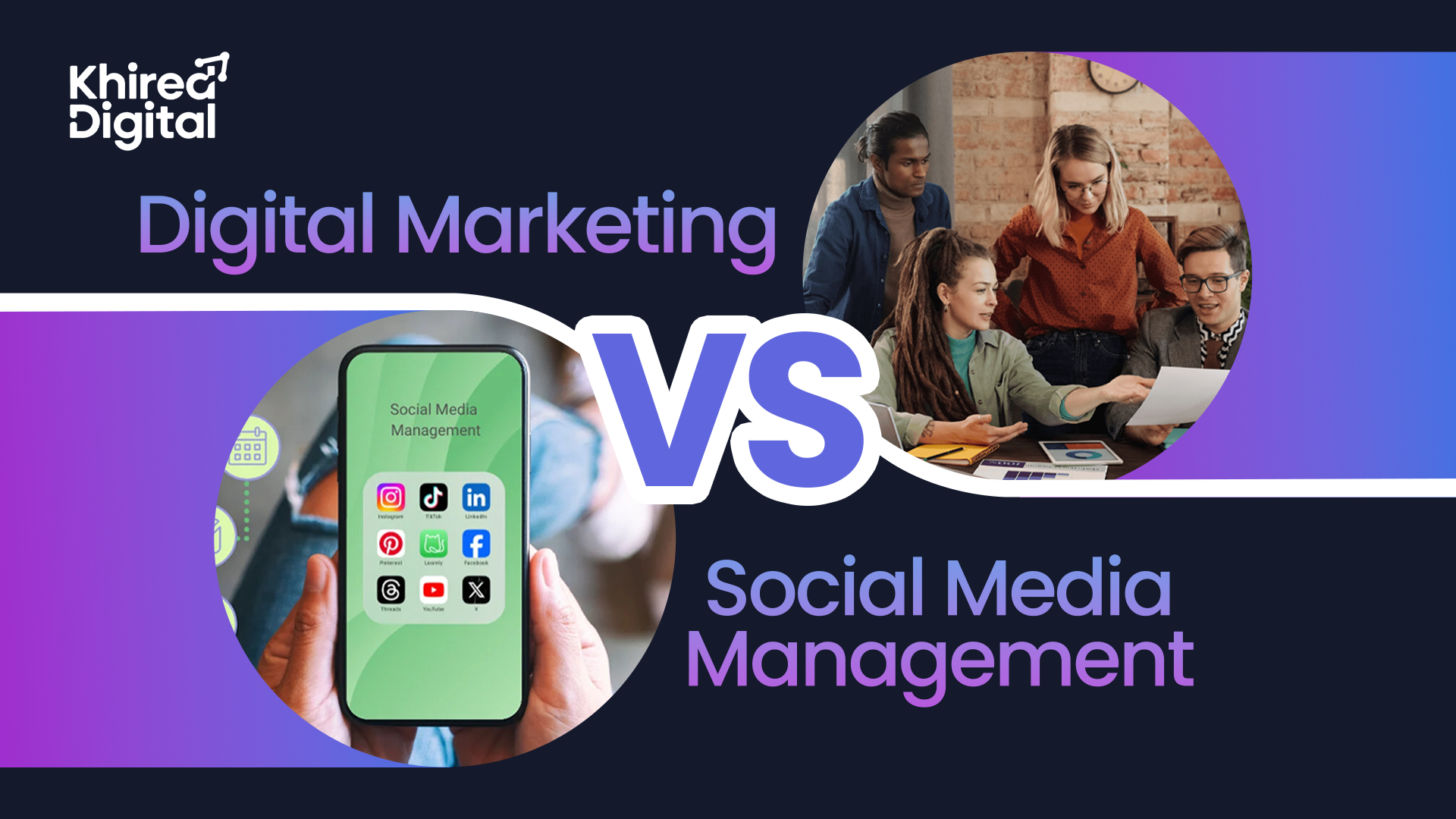
While 71% of marketers say social media is essential to their business, only 15% can directly tie their social media efforts to revenue—revealing the critical gap between execution and strategic planning.
Imagine constructing a house. Social media management makes the area liveable and appealing by just arranging the furniture, hanging artwork, and setting the mood with lighting. But it is the architectural blueprint, the foundation, the plumbing, and the electrical wiring—what originally renders the house structurally sound and practical, i.e., digital marketing.
The core distinction between the two fields is that one is the high-level plan directing all efforts toward a business goal, and the other is the crucial, daily implementation on a particular group of platforms. Many companies experience little actual expansion yet seem busy online since they either confuse them or give one over the other priority.
In this blog, we’ll discuss the main roles depicting the differences between digital marketing and social media management.
Defining the Roles
The primary overall strategy is digital marketing. Achieving particular business goals like rising revenue, producing leads, or establishing brand recognition requires a thorough plan using all digital channels: search engines (SEO/SEM), email, websites, content, and social media. Like an architect, a digital marketer asks: What is the target audience? What is the client journey? What is the objective? They oversee the budget, monitor the general ROI, and guarantee every strategy matches the grand scheme.
Whereas social media management is a part of that approach that concentrates just on implementation inside social media sites like Facebook, Instagram, TikTok, and LinkedIn. The interior designer is the social media manager who actualizes the architect’s plans in these particular spaces. Their knowledge is in brand voice, content development, community involvement, and platform algorithms. Targeting to create community, stimulate discussion, and generate engagement on their assigned channels, they follow the strategy established by the digital marketing plan.
The Strategy Phase: Where Digital Marketing Leads
This is the thought stage. The digital marketing plan addresses basic questions before any one post is scheduled. It entails thorough market research, competitive analysis, and identification of your own unique value proposition. From awareness to purchase, it charts the path of the client and determines which channels are most successful at every level. The plan may call, for example, LinkedIn for B2B lead generation, Instagram for brand storytelling, and Google Ads for high-intent search traffic acquisition.
This stage determines the KPIs—website traffic, lead conversion rates, customer acquisition cost, as well as likes. Without this strategy, social media campaigns are like yelling into a vacuum without knowing who’s listening or what you would want them to do.
The Execution Phase: Where Social Media Management Excels
Social media management gives life to the plan with inventiveness and accuracy once it is in place. This is the implementation phase. Creating the calendar, writing the captions, designing the visuals, filming the Reels, and addressing DMs and comments are all part of it.
A good social media manager knows the subtleties of every platform: the ideal time to publish on TikTok versus LinkedIn, how to write a viral X thread, or what kind of Reels hooks viewers. Their success is judged by sentiment analysis, follower growth, and engagement indicators. Directly affecting how the brand is viewed in their daily audience’s scroll, their work is physical and public-facing. Their work, though, is directed by the goals and messaging established in the larger digital marketing plan.
The Symbiotic Relationship: Why You Cannot Have One Without the Other
A plan without implementation is nothing more than a document collecting dust. Execution without strategy wastes resources and energy. They depend on one another. For instance, a digital marketing plan might find a need to boost sales of a recently introduced item. The social media manager then implements a targeted campaign.
Also, they generate instructional videos addressing the consideration stage, run a giveaway to generate interest, and use shoppable posts to spur direct sales. The content from the social media manager offers audience comments and real-time data that the digital marketer refines the general plan with. It’s a feedback-driven cycle whereby execution informs strategy and strategy shapes execution.
Common Pitfall: Confusing Execution for Strategy
Companies most often misunderstand that having a digital marketing plan is not equivalent to participating on social media. This produces the “posting and praying” approach, whereby ongoing activity without a specific purpose or quantifiable company effect results. You could have great engagement but no sales.
The symptom is asking, “We post every day, so why aren’t we growing?” Almost always, the solution is the absence of an all-encompassing digital marketing plan connecting social activity to a business funnel, specifying the target consumer beyond demographics, and having a mechanism for transforming fans into leads and consumers.
Building Your Team: Do You Need a Strategist, a Manager, or Both?
One person could wear both hats for a small firm or new company, but they must intentionally divide the tasks in their daily operations. They must give strategic planning (setting quarterly objectives, examining data, creating campaigns) and execution (daily posting, engagement) time. Usually, these jobs start to become specialized as a business expands.
While a social media manager or coordinator concentrates on content creation and community building, a digital marketing manager or director works on the strategy, budget, and multi-channel integration. Fixing the disconnection starts with identifying which function is missing in your current attempts.
Strategy vs Execution: A Quick Comparison Table
Aspect | Digital Marketing (Strategy) | Social Media Management (Execution) |
Scope | Broad (All Digital Channels) | Narrow (Social Platforms Only) |
Focus | Why and What (Goals, Audience, Funnel) | How and When (Content, Engagement, Timing) |
Primary Goal | Drive Business Outcomes (Revenue, Leads) | Build Community & Brand Presence |
Key Metrics | ROI, Conversion Rate, CAC, LTV | Engagement Rate, Reach, Follower Growth |
Mindset | Analytical, Architectural | Creative, Conversational |
Final Thoughts
Digital marketing and social media management are not adversaries; they are rather crucial allies in an effective internet presence. View digital marketing as the brain—directing and strategic decision-making.
Creating the human connection and carrying out the plan creatively, social media management is the voice and core. Your company needs both a strategic framework and skilled craftsmen to create it to really flourish online. Ignoring one in preference of the other renders your firm incomplete, either directionless or silent.
Ready to match your strategy with faultless execution? Contact Khired Digital to create a unified digital marketing strategy that converts social media engagement into quantifiable business growth.
Frequently Asked Questions
Can a social media manager become a digital marketer?
Precisely. It is a typical professional path. Already considered like a digital marketer, a social media manager with a data interest investigates how social efforts influence website traffic and sales by going beyond engagement. The change entails adding SEO, email marketing, and analytics to their repertoire of talents.
We have great engagement but no sales. What's wrong?
This is a traditional indication of execution without planning. Although probably interesting, your social material is not meant to lead your audience along a route culminating in a transaction. You have to have a strategic funnel that uses interesting content to create trust, then provides a clear, low-commitment next step (such as visiting a landing page or signing up for a webinar) that pushes them toward becoming a client.
Which should I invest in first?
Always begin with strategy. Your social media execution will be ten times more successful if even a simple digital marketing plan specifies your objectives, target audience, and main messages. It’s better to carry out a modest strategy with concentration than to carry out a great one without any.

0 Comments