WhatsApp
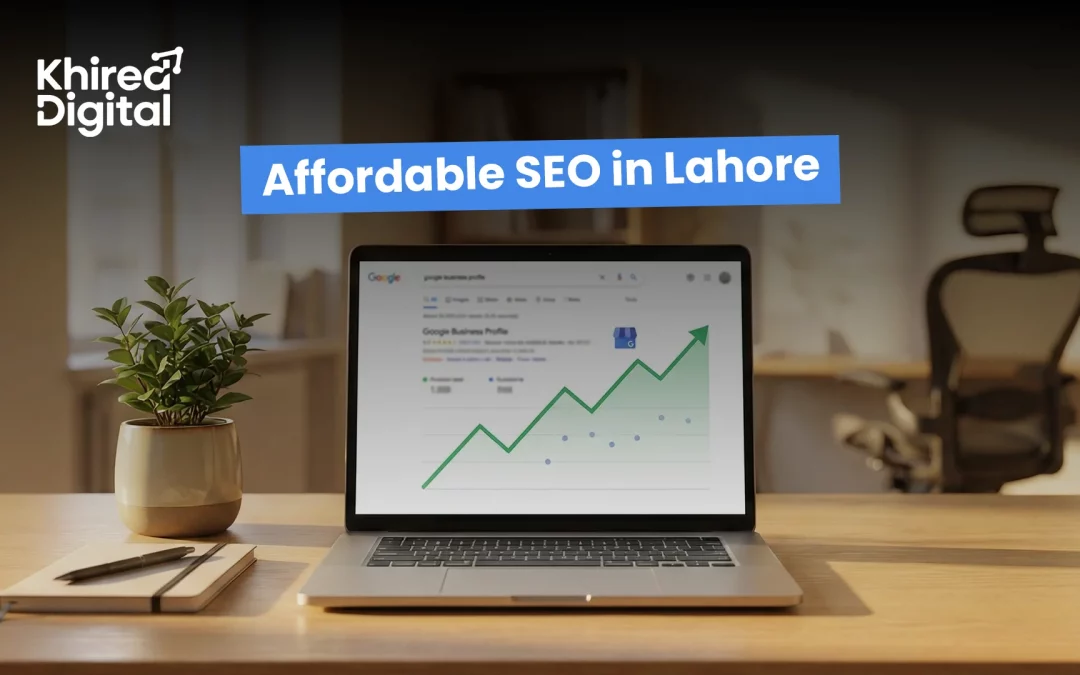
Affordable SEO in Lahore: What You Get & What You Should Avoid

Affordable SEO in Lahore: What You Get & What You Should Avoid

Meet Bilal. He runs a small bakery in Lahore’s DHA. His cakes were delicious, his customers loved him, but his business was struggling. People in his neighborhood kept ordering from a competitor three blocks away—because that competitor showed up on Google when anyone searched “birthday cake near me.”

Bilal needed help. He found an “SEO expert” on Facebook offering guaranteed page one rankings for just PKR 15,000. No contract. Quick results. It sounded perfect.

Within weeks, Bilal’s website traffic skyrocketed. He was thrilled.

Then Google released an update.

Overnight, his website vanished from search results. Not page two. Not page ten. Gone. Completely de-indexed. The “SEO expert” had used black hat tactics—buying thousands of spammy links from low-quality websites. Google penalized Bilal’s site so severely that recovery would take months, if ever. 

Bilal learned a hard lesson: cheap SEO is expensive in the long run.

If you’re a business owner in Lahore looking for affordable SEO services in Lahore, this guide is for you. You’ll learn what genuine SEO includes, what you should absolutely avoid, and how to find experts who deliver real, sustainable results—without breaking the bank or risking your business. 

What is Affordable SEO (And What It Is Not)

Let’s clear up a major confusion. Affordable SEO does not mean cheap SEO.

Cheap SEO 

Affordable SEO 

PKR 5,000–15,000/month 

PKR 25,000–60,000/month 

Guarantees page one rankings 

Provides realistic timelines 

Uses black hat tactics 

Uses white hat techniques 

Results disappear after updates 

Results are sustainable 

No reporting or transparency 

Regular detailed reports 

Your site risks Google penalty 

Your site builds long-term authority 

Affordable SEO means getting good value for your money—quality work at a fair price. Not the cheapest option, but the option that delivers actual return on investment. 

In Lahore, a quality SEO package for a small to medium business typically ranges from PKR 25,000 to 60,000 per month. Anything significantly lower should raise red flags. 

What You Should Get

When you hire genuine SEO services in Lahore, here’s what quality looks like:

1. Comprehensive Website Audit

A proper SEO provider starts with a thorough audit of your website. They check: 

  • Technical issues (broken links, slow loading, mobile responsiveness) 
  • On-page elements (title tags, meta descriptions, headers) 
  • Content quality and relevance 
  • Backlink profile health 

Red flag: They start “optimizing” without analyzing your current situation first.

2. Keyword Research and Strategy

SEO Experts don’t guess which keywords to target. They use tools like Ahrefs, Semrush, or Google Keyword Planner to find: 

  • Keywords your ideal customers are searching for 
  • Search volume and competition level 
  • “Long-tail keywords” (specific phrases like “affordable birthday cakes in Lahore DHA”) that convert better 

Red flag: They promise to rank you for broad, competitive keywords like “bakery” or “cakes” without explaining how difficult that is.

3. On-Page Optimization

This includes optimizing every page of your website: 

  • Title tags and meta descriptions 
  • Header structure (H1, H2, H3) 
  • Image alt text 
  • Internal linking 
  • URL structure 
  • Content optimization for target keywords 

Red flag: They only talk about “backlinks” and ignore on-page optimization entirely.

4. Local SEO (Crucial for Lahore Businesses)

If you serve customers in a specific area, Local SEO in Lahore is essential. Quality providers will:

  • Claim and optimize your Google Business Profile 
  • Ensure your Name, Address, Phone number (NAP) is consistent across the web 
  • Build local citations on Pakistani directories 
  • Manage and respond to Google reviews 
  • Optimize for “near me” searches 

Why this matters: 82% of smartphone shoppers conduct “near me” searches. If your Google Business Profile isn’t optimized, you’re invisible to local customers.

5. Quality Content Creation

Content is the foundation of SEO. You should receive: 

  • Blog posts targeting relevant keywords 
  • Service page optimization 
  • FAQ sections that answer customer questions 
  • Fresh, original content (not AI-generated garbage) 

Red flag: They outsource content to cheap writers who don’t understand your industry or use AI to mass-produce low-quality articles.

6. White Hat Link Building

Backlinks from reputable websites signal to Google that your site is trustworthy. Quality link building includes: 

  • Guest posting on relevant Pakistani websites 
  • Digital PR and outreach 
  • Directory submissions (quality directories, not spammy ones) 
  • Building relationships with industry partners 

Red flag: They promise “500 backlinks in 30 days” or use automated link-building tools. This is black hat and will get you penalized.

7. Monthly Reporting and Transparency

You should receive a clear report every month showing: 

  • Keyword ranking changes 
  • Organic traffic growth 
  • Backlinks acquired 
  • Technical issues fixed 
  • Goals for next month 

Red flag: They send vague reports with “page one rankings” for irrelevant keywords or refuse to share data. 

What You Should Absolutely Avoid 

Now for the warning signs. If you see any of these, run the other way. 

Avoid 1: Guaranteed Page One Rankings 

No legitimate SEO expert can guarantee page one rankings. SEO involves hundreds of factors, including competitor behavior and Google algorithm updates. Anyone promising “guaranteed #1 position” is lying. 

What they should say instead: “Based on our analysis, we expect to see significant improvement in 3-6 months, but SEO has no guarantees.” 

Avoid 2: Extremely Low Prices

If someone offers SEO services in Lahore for PKR 5,000–10,000 per month, ask yourself: how can they deliver quality work for that price? They can’t. They’re either: 

  • Using automated tools that risk your site 
  • Outsourcing to unskilled workers 
  • Using black hat tactics that will eventually penalize you 

Remember: Quality SEO requires time, expertise, and tools that cost money. You get what you pay for. 

Avoid 3: Secret Methods or “Proprietary Techniques” 

If they refuse to explain what they’re doing because it’s a “secret algorithm” or “proprietary method,” they’re hiding something. White hat SEO is transparent. You should understand every tactic being used on your site. 

What they should do: Explain their strategy clearly, including the tools they use and the reasoning behind each action. 

Avoid 4: Link Farms and PBNs (Private Blog Networks) 

Some providers will build hundreds of low-quality links from spammy websites. This works temporarily, then Google catches on and penalizes you. Recovery can take months or years. 

How to spot this: Ask for a list of websites where they’ll build links. If the sites look fake, have no real content, or are irrelevant to your industry, say no. 

Avoid 5: Ignoring Local SEO 

If you’re a local business in Lahore and your provider only focuses on “global rankings” while ignoring Local SEO in Lahore, they don’t understand your business. Ranking #1 globally means nothing if customers in your neighborhood can’t find you. 

What you need: A provider who prioritizes Google Business Profile optimization, local citations, and “near me” searches. 

Avoid 6: Overpromising on Timeline 

SEO takes time. Real results typically take 3-6 months. Anyone promising “results in 2 weeks” is either: 

  • Using black hat tactics 
  • Showing you fake data 
  • Ranking you for irrelevant keywords no one searches 

Reasonable timeline: Month 1-2: Technical fixes and foundation. Month 3-4: First signs of improvement. Month 6+: Significant traffic growth. 

The Role of AI in SEO (What’s Real and What’s Hype)

AI SEO is a hot topic in 2026. Here’s what you need to know: 

What AI Can Do: 

  • Analyze large amounts of data faster than humans 
  • Suggest content topics based on search trends 
  • Help with keyword research and clustering 
  • Automate certain reporting tasks 
  • Generate content outlines and drafts

What AI Cannot Do: 

  • Understand your unique brand voice and customer psychology 
  • Build genuine relationships for link building 
  • Make strategic decisions based on business goals 
  • Replace human expertise and judgment 
  • Guarantee results 

The truth: The best SEO providers use AI as a tool to work faster and smarter. They don’t rely on AI to replace their expertise. If a provider claims to offer “fully automated AI SEO” for a low price, be very sceptical. 

How Much Should You Pay for SEO in Lahore?

Based on market research and industry standards, here’s what you can expect to pay for quality SEO services in Lahore in 2026:

Business Type 

Monthly Investment (PKR) 

What’s Included 

Small local business (bakery, salon, clinic) 

25,000–40,000 

Local SEO, on-page optimization, basic content, citations 

Medium business (e-commerce, multiple locations) 

40,000–70,000 

Everything above plus link building, advanced content 

Large business (enterprise, national brand) 

70,000–150,000+ 

Full strategy, competitive analysis, advanced link building 

Off page SEO in Lahore (link building specifically) often costs extra, ranging from PKR 5,000–15,000 per quality backlink. 

Questions to Ask Before Hiring an SEO Provider

Before signing any contract, ask these questions: 

  1. “Can you share case studies of Lahore businesses you’ve helped?” – Look for real examples with data. 
  2. “What SEO tools do you use?” – Legitimate providers use tools like Ahrefs, Semrush, Moz, or Google Search Console. 
  3. “How do you build backlinks?” – The answer should include guest posting, outreach, and relationship building—not “we buy links.” 
  4. “How will you report progress?” – They should offer monthly reports with clear metrics. 
  5. “What happens if I cancel?” – You should own all work done (content, optimizations, etc.). 
  6. “Do you guarantee rankings?” – If they say yes, walk away. 

Conclusion

Bilal, the baker from our introduction, eventually recovered. It took six months of painstaking work with a legitimate SEO provider to clean up the damage from his cheap “expert.” He paid more in the long run—not just in money, but in lost sales and sleepless nights. 

Today, Bilal’s bakery ranks #1 for “birthday cake near me” in his area. His business is thriving. And he learned a valuable lesson: when it comes to SEO, cheap is expensive. 

If you’re a business owner in Lahore looking for affordable SEO services in Lahore, remember this guide. Look for transparency, realistic promises, and a focus on sustainable white hat techniques. Avoid guarantees, extremely low prices, and secret methods. 

SEO is an investment in your business’s future. Done right, it pays for itself many times over. Done wrong, it can destroy your online presence. 

Choose wisely. Grow steadily. And watch your business rise. 

Ready to grow your business with ethical, affordable SEO? At Khired Digital, we specialize in white hat SEO strategies for Lahore businesses. From local SEO to quality link building, we deliver real, sustainable results—no black hat, no guarantees, just honest work that pays off. 

Partner with Khired Digital today, and let’s put your business on the map.

Frequently Asked Questions

What is the difference between on-page and off-page SEO in Lahore? 

On-page SEO refers to optimizations made directly on your website—title tags, meta descriptions, content, headers, internal links, and technical fixes. Off-page SEO in Lahore refers to activities outside your website that impact rankings, primarily link building (getting other websites to link to you). Both are essential. A good provider does both.

How long does it take to see results from SEO? 

SEO is a long-term strategy. Most businesses see initial improvements within 3-4 months and significant traffic growth within 6-12 months. Local SEO for a Lahore business may show results faster (2-3 months) because local competition is often lower. 

Is AI SEO a replacement for human SEO experts?

No. AI SEO tools are powerful assistants that help with data analysis, content suggestions, and automation, but they cannot replace human expertise. AI doesn’t understand your customers, your brand voice, or your business goals. It cannot build genuine relationships for link building or make strategic decisions. The best approach is combining AI tools with human expertise—using technology to work smarter, not replacing the expert.

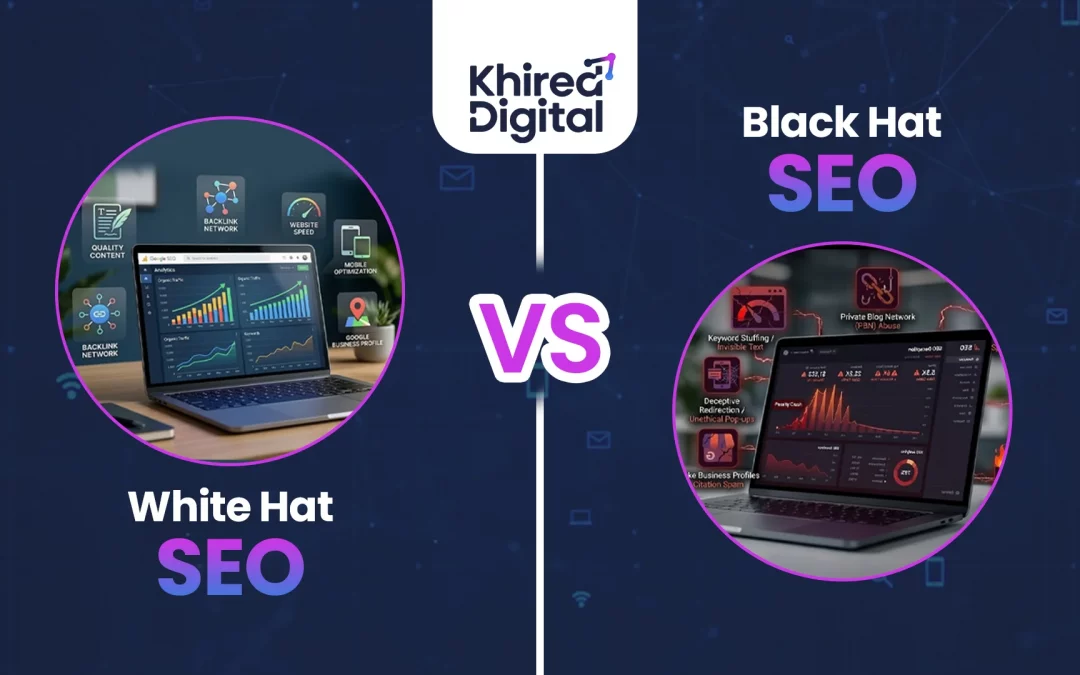
White Hat SEO vs Black Hat SEO: Which Strategy Wins in 2026?

White Hat SEO vs Black Hat SEO: Which Strategy Wins in 2026?

Two friends, Ali and Sara, both launched e-commerce stores in Lahore at the beginning of 2025.

Ali was impatient. He wanted to rank number one overnight. He found a freelancer who promised him 500 backlinks for PKR 15,000. The links were from obscure websites with gibberish domain names, but within weeks, Ali was ranking on page one for several keywords. He celebrated. Business was booming.

Sara took a different path. She invested in understanding her customers, wrote detailed blog posts about her products, optimized her website for mobile users, and patiently built relationships with genuine bloggers in her niche. After three months, she was barely on page two.

Then came Google’s March 2025 Core Update—the longest on record at 45 days.

Overnight, Ali’s traffic vanished. His site, flagged for “unnatural links,” was deindexed. He lost 95% of his organic traffic within 72 hours. Six months later, his business closed.

Sara, on the other hand, saw a steady climb. By early 2026, she dominates her niche, her customers trust her, and her rankings are stable through every algorithm update.

This is the difference between white hat SEO and black hat SEO in 2026. And the stakes have never been higher.

What is White Hat SEO?

White hat SEO refers to ethical optimization strategies that fully comply with search engine guidelines. The philosophy is simple: put users first. When visitors find your content genuinely useful, search engines reward your site over time. 

Think of white hat SEO as building a brick house. It takes time, effort, and patience, but when the storm comes, it stands firm. 

White hat SEO techniques focus on creating genuine value:

  • Quality content creation that matches search intent and demonstrates expertise  
  • Mobile optimization and fast loading speeds (Core Web Vitals)  
  • Natural link acquisition through guest posting, digital PR, and relationship building  
  • Proper on-page optimization with clear title tags, meta descriptions, and header hierarchies  
  • Claiming and optimizing your Google Business Profile for local visibility 

The results may take 3-6 months to materialize, but they’re sustainable, penalty-free, and build genuine brand authority. 

What is Black Hat SEO?

Black hat SEO encompasses manipulative tactics that violate search engine guidelines to artificially inflate rankings. These techniques prioritize gaming algorithms over serving users. 

Think of black hat SEO as building a house of cards. It looks impressive quickly, but the slightest wind (or algorithm update) brings it crashing down. 

Common black hat SEO tactics in 2026 include: 

  • Private Blog Networks (PBNs) – networks of websites created solely to provide backlinks  
  • AI-generated content spam – mass-producing low-quality articles with minimal human oversight  
  • Cloaking – showing different content to search engines than to users  
  • Keyword stuffing—unnaturally forcing keywords into content  
  • Parasite SEO – publishing content on high-authority third-party sites to hijack their authority 

The consequences are severe. Google’s March 2024 update eliminated 45% of low-quality content from search results, with 837 websites completely deindexed. Research shows that only 30% of penalized websites recover their rankings within a year. Even more alarming, industry data indicates that 40% of businesses cease operating within six months of receiving a Google penalty.

Why 2026 is the Tipping Point

The battle between white hat and black hat SEO has reached a decisive moment. Artificial intelligence has fundamentally changed how search engines evaluate content.

Google’s SpamBrain system now detects AI-generated content through predictability analysis. If Google’s systems can predict the next word too accurately, it signals machine authorship. Sites relying solely on AI content lost an average of 17% of traffic and dropped 8 positions in rankings.

Furthermore, AI Overviews now appear in approximately 30% of all search results and 74% of problem-solving queries. Organic click-through rates for position one dropped from 28% to 19%—a 32% decline—after AI Overviews expanded. But here’s the twist: positions 6–10 saw CTRs increase by over 30% year-on-year as users scroll past AI summaries seeking deeper, nuanced content.

What do search engines want in 2026? Content that demonstrates Experience, Expertise, Authoritativeness, and Trustworthiness (E-E-A-T). The content should have a clear structure, verifiable data, original research, and genuine expertise.

The Verdict: Which Strategy Wins?

Let’s look at the numbers:

Factor 

White Hat SEO 

Black Hat SEO 

Time to results 

3-6 months 

Immediate 

Risk of penalty 

Near zero 

Extreme (45% content elimination) 

Recovery from penalty 

N/A 

Only 30% recover within a year 

Business survival rate 

High 

40% fail within 6 months of penalty 

ROI (3-year) 

702% for B2B companies 

Negative (lost investment + penalty) 

The conclusion is undeniable: white hat SEO services are the only rational choice for businesses in 2026. Black hat tactics represent an existential risk to your organic visibility and your entire business. 

As Google’s John Mueller put it, “Building a business on risky practices seems like a terrible idea.” 

How to Build a Sustainable White Hat Strategy

If you’re ready to invest in ethical, long-term growth, focus on these proven white hat SEO techniques:

  1. Create content that answers real questions—study what your audience searches for and deliver comprehensive, valuable answers.
  2. Optimize for mobile first – Google uses mobile-first indexing. Your site must perform flawlessly on phones.
  3. Build genuine relationships—Earn links through guest posting, digital PR, and creating content so good that people naturally reference it.
  4. Claim your Google Business Profile—82% of smartphone shoppers conduct “near me” searches. Be visible locally.
  5. Prioritize user experience – Fast loading, easy navigation, and clear calls-to-action keep visitors engaged.

Conclusion

The story of Ali and Sara that opened this article isn’t hypothetical. It plays out every day across Pakistan and around the world. One business takes the shortcut and crashes. Another builds patiently and thrives. 

In 2026, with AI-powered search engines smarter than ever and penalties more devastating than ever, the choice is clear. White hat SEO isn’t just the ethical choice—it’s the only profitable long-term strategy. 

Ready to build sustainable rankings that survive every algorithm update? Don’t gamble with your business future. At Khired Digital, we specialize in white hat SEO strategies tailored for the Pakistani market. From content creation to technical optimization, we help you grow the right way.

Partner with Khired Digital Today and build rankings that last.

Frequently Asked Questions

What is the difference between white hat and black hat SEO? 

The distinction comes down to intent and methods. White hat SEO focuses on creating genuine value for users through quality content, good user experience, and earning links through merit. It fully complies with search engine guidelines. 

Black hat SEO manipulates search algorithms to achieve rankings the content doesn’t deserve, using tactics like link schemes, keyword stuffing, and cloaking. These techniques violate search engine guidelines and risk severe penalties, including complete removal from search results. 

Think of it this way: white hat builds a business; black hat builds a gamble. 

What are white hat SEO techniques? 

White hat SEO techniques are ethical optimization strategies that prioritize user value and comply with search engine guidelines. Key techniques for 2026 include the following: 

  • High-quality content creation that matches search intent and demonstrates E-E-A-T (Experience, Expertise, Authoritativeness, Trustworthiness)
  • Mobile-first optimization ensuring your site performs flawlessly on smartphones
  • Natural link building through genuine relationships, guest posting, and digital PR
  • Technical excellence, including fast page speeds, proper schema markup, and clean site architecture
  • Local SEO optimization, like claiming your Google Business Profile and managing citations

These techniques build sustainable rankings that survive algorithm updates and grow your business over time.

Can black hat SEO ever work in 2026?

Short answer: No, not safely. While black hat tactics might generate short-term ranking spikes, Google’s AI-powered detection systems identify manipulative patterns almost instantly. The March 2024 update eliminated 45% of low-quality content and completely deindexed 837 websites.

Consider the math: with only 30% of penalized sites recovering within a year and 40% of affected businesses failing within six months of a penalty, the risk-reward ratio has never been worse. Meanwhile, ethical SEO (search engine optimization) delivers 702% ROI (return on investment) for B2B (business-to-business) companies and builds assets that appreciate over time.

In 2026, choosing black hat isn’t just risky—it’s potentially business-ending.

10 Best Affordable SEO Services for Small Businesses in 2026

10 Best Affordable SEO Services for Small Businesses in 2026

It’s a damp Thursday afternoon in Karachi. Eman’s air conditioner has failed during a heat wave. She types, “best AC repair near me in Karachi”, on her phone.

The results load immediately.

On her map, there are five green pins. She clicks the first number to call after reading a few reviews and viewing the star ratings. A technician is at her doorstep within an hour, and her air conditioner is mended by nightfall. 

Now, the million-rupee question here is: Was that technician you?

In 2026, this scene plays out countlessly daily across Pakistan. Every near me search is a digital customer raising their hand, prepared to buy. But Eman won’t see you if your company is not on that initial page, if you are not on that map. She won’t go to page two to locate you. She won’t hunt for your company’s name. She will just contact your rival. 

This is what contemporary business is all about. Visibility is everything. Through a wise, regular, and inexpensive SEO service is the only way you can be certain you will appear for that search.

The encouraging news is this: To get there, you don’t need a marketing budget the size of a transnational corporation. 2026 presents more economical routes to the top of Google than ever before, whether you are a plumber in Lahore, a boutique in Islamabad, or a dental office in Peshawar.

The top ten methods to guarantee that Eman, a consumer, first discovers you when she searches for you are listed below. 

Affordable SEO Services: What Small Businesses Need to Know

Before watching the list, it’s crucial to understand what “affordable” means this year. The SEO market has matured. According to recent data, most small businesses pay between $1,000 and $3,000 per month for serious, results-driven local SEO. However, affordability isn’t just about the monthly price tag—it’s about access to tools and strategies that were once reserved for enterprises. 

Today, a truly affordable SEO service must address three core areas: 

  1. Traditional SEO: Technical audits, on-page optimization, and link building. 
  2. Local Dominance: Google Business Profile optimization and local citations. 
  3. AI Readiness: Structuring content for AI overviews and answer engines (GEO). 

Here are the 10 best ways to access these services affordably in 2026.  

1. Comprehensive Local SEO Packages

For businesses with a physical location or a specific service area, local SEO is non-negotiable. In Pakistan, for example, over 65% of smartphone users have utilized “near me” searches. 

Affordable local SEO services focus on optimizing your Google Business Profile, building consistent local citations on platforms like HamariWeb, and managing online reviews. The best part? These targeted strategies often cost less than broad, national campaigns because they focus on high-intent, local traffic.

2. AI-Powered SEO Platforms (The New Standard)

Gone are the days when small businesses had to choose between expensive enterprise tools like Ahrefs or Semrush and cheap, ineffective alternatives.

In 2026, platforms like Clearscope have shifted their pricing models to be accessible to freelancers and small teams. These tools help you optimize for search intent, discover the right keywords, and structure your content to rank in both traditional and AI-driven search environments. Paying for one good platform often replaces the need for five mediocre ones.

3. Flat-Rate Marketing Agencies

Predictability is key for a small business budget. Agencies like Lion Heart Advertising have pioneered all-inclusive marketing packages for a flat monthly fee (e.g., $488.88), which includes website optimization, Google Business Page management, and citation building. This model strips away the complexity of variable costs and provides a clear, affordable framework for generating leads.

4. Specialized Local SEO Consultancies

Sometimes, the best value comes from agencies that deeply understand your specific market. For businesses in Pakistan, working with a local expert like Khired Digital ensures that your strategy aligns with cultural nuances and local search behavior. These agencies offer affordable, results-driven packages focusing on dominating the “Map Pack” and driving foot traffic, ensuring your marketing rupees are spent exactly where they matter most.

5. Scalable Startup SEO Retainers

If you are a micro-business or startup, you don’t need an enterprise strategy. You need a roadmap. Many agencies now offer “Start” packages priced around $500 to $2,000 per month (or equivalent in PKR). These typically include a technical audit, keyword mapping for a core set of themes, and optimization of your most important pages . The focus here is on building a foundation that can scale as you grow.

6. Affordable Content Optimization Services

Context is God; material is still king. Rather than just keyword stuffing, inexpensive services now center on search intent optimization. This entails developing FAQ pages and topic clusters that directly address consumer queries—a technique also useful in appearing in AI-generated responses. Little companies can experience large increases in traffic without enormous content expenditures by recycling previously produced material and fine-tuning it for clarity.

7. Budget-Friendly Link Building Agencies

Domain authority can be built without a $300 per link expense. Starting at as little as $60 to $100, guest post and specialty edit packages are offered by Ranktracker, Loganix, and Authority Builders, among others. These services help small enterprises establish trust with Google without the hefty price tag of digital PR companies by obtaining links from pertinent, indexable domains.

8. Hybrid PPC & SEO Management

Visibility calls for both long-term stability and quick victories. Modern integrated tactics link Google Ads management with organic SEO via inexpensive agencies like Best PPC Firm. Small businesses using this strategy can swiftly capture traffic with paid advertisements while their SEO efforts create a lasting organic basis. This inexpensive means of assuring you are not invisible will help you while you wait for SEO to start working.

9. Technical SEO Audits & Fixes

Google’s inability to crawl a gorgeous website renders it worthless. Many inexpensive suppliers provide one-time technical SEO audits for a flat project price (usually between $5,000 and $30,000 based on website size, even if smaller audits are considerably less). These audits find mobile usability problems, slow loading times, and busted links. Often, the most return on investment a small company can engage in is correcting these technical hurdles.

10. Freelance SEO Specialists

Many times, the most economical choice is a brilliant person. Upwork and Fiverr have certified SEO freelancers, including top-tier Pakistani talent. Using a freelancer for a particular assignment, such as a thorough keyword study or a one-time website clean-up, can be significantly less expensive than an agency retainer, therefore providing you with flexibility and access to specialized talents as needed. 

Final Thoughts

In 2026, your customers are searching online first. Your business search engine visibility determines whether customers find your business or a competitor. The good news is that you don’t need a Fortune 500 budget to compete. The proper combination of budget-friendly SEO services, which include local optimization and AI-ready content, will help your business develop a strong online presence that creates lasting growth.

Are you prepared to take control of the search results that operate in Pakistan? Your competitors will keep taking your customers until you act. Khired Digital creates budget-friendly SEO solutions that establish connections between Pakistani businesses and their local markets. We serve as your digital success partner through our Google My Business optimization and content strategy development services.

Khired Digital invites you to join us in establishing your business presence in the market.

Frequently Asked Questions

How much should a small business expect to pay for SEO in 2026?

For a serious, results-driven local SEO campaign, small businesses typically pay between $1,000 and $3,000 per month. However, for very small startups or micro-businesses, retainers can start as low as $500 per month, focusing on the most critical fixes and strategies. In Pakistan, local agencies may offer more competitive packages suited to the regional economy. 

What is the difference between cheap SEO and affordable SEO? 

Cheap SEO focuses on the lowest price tag, often using black-hat tactics like link farming or keyword stuffing that can get your site penalized by Google. Affordable SEO focuses on return on investment (ROI). It means paying for a service that provides a clear strategy, transparent reporting, and sustainable growth—even if it costs slightly more upfront. An affordable service pays for itself by driving qualified traffic that converts into customers. 

Can I do SEO myself, or should I hire a professional? 

The basic SEO tasks that you can perform include claiming your Google Business Profile and verifying NAP data across multiple websites. The process of technical audits, competitive keyword analysis, and link building requires you to hire experts who possess specialized knowledge. The growing complexity of AI search algorithms in 2026 requires expert assistance to ensure your content achieves visibility on all platforms.

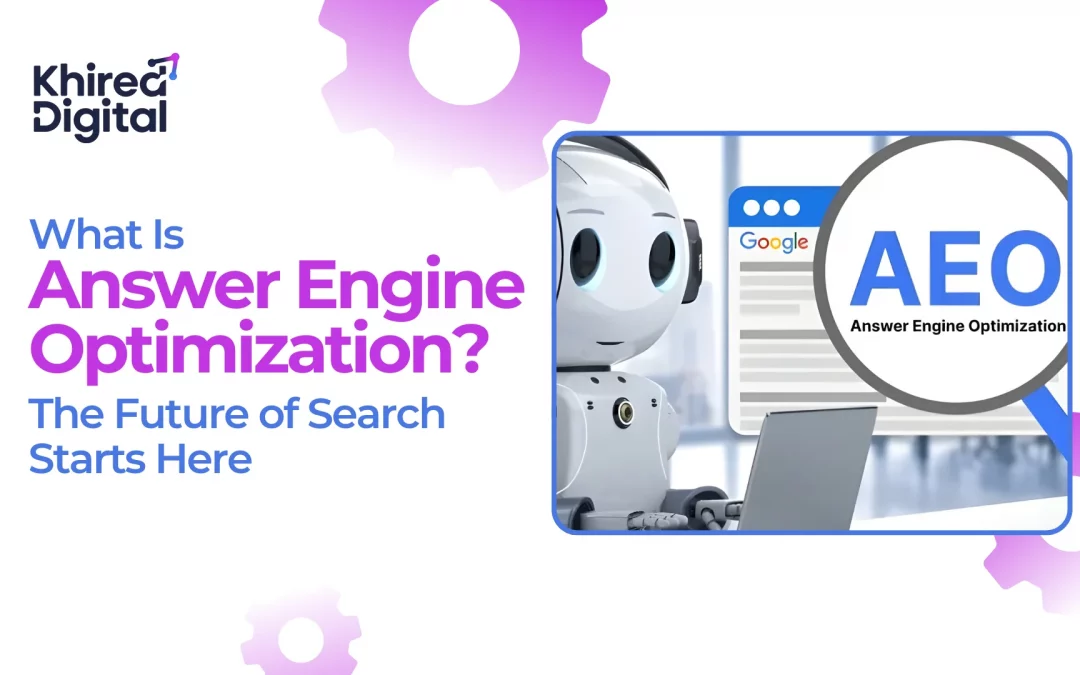
What Is Answer Engine Optimization? The Future of Search Starts Here

What Is Answer Engine Optimization? The Future of Search Starts Here

Imagine this: You’re craving Italian food and ask your smart speaker, “What’s the best Italian restaurant near me?” Instead of a list of links, a calm voice responds, “Based on reviews, Trattoria Roma on Main Street is highly recommended for its authentic pasta and cozy atmosphere.” 

You never see a website. You never click a link. Yet a restaurant just got your business without you ever visiting their site. This is the new reality of search, powered by Answer Engine Optimization (AEO). The days of scrolling through blue links are fading.

Welcome to the era of instant answers!!!

What Is Answer Engine Optimization?

Answer Engine Optimization (AEO) is the practice of optimizing your content so it’s easily discovered, understood, and cited by AI-powered answer engines like Google’s AI Overviews, ChatGPT, Perplexity, Amazon Alexa, and Apple’s Siri. Unlike traditional search engines that return a list of website links for users to click and explore, answer engines provide immediate, concise, direct answers to user questions—often without requiring any click at all. 

Think of it this way: if traditional search engines are like library catalogs pointing you to books on a shelf, answer engines are like knowledgeable librarians who simply tell you the answer. Your goal with AEO is to become the source that the librarian trusts and quotes.

How Is Answer Engine Optimization Different from SEO?

This is where many marketers get confused. While AEO and traditional SEO share some common ground, they serve fundamentally different purposes and operate on different mechanics. 

Aspect Traditional SEO Answer Engine Optimization (AEO) 
Primary Goal Rank higher in search results to drive clicks Become the cited source in direct AI answers 
Success Metric Impressions, clicks, organic traffic Citation frequency, share of voice in AI responses 
Content Focus Keyword density, backlinks, page authority Direct answers, structured data, factual consensus 
User Experience Users click through to browse your site Users get answers immediately without clicking 
Key Mechanism Link-based authority and keyword matching Entity recognition and semantic understanding 

Traditional search engines retrieve documents containing keywords and leave users to extract answers themselves. Answer engines, however, understand intent, synthesize information from multiple trusted sources, and generate complete responses. 

This fundamental shift means ranking #1 on Google matters little if an AI Overview sits above your link and users never scroll down to see it. In fact, zero-click searches now represent approximately 59% of Google searches, and when AI Overviews appear, click-through rates can drop to just 8%. 

Why AEO Matters Now: The Stats You Can’t Ignore

The shift to answer engines isn’t coming—it’s already here. Consider these eye-opening statistics: 

  • 59% of searches now end without a click to a website, as users find answers directly on search results pages. 
  • Gartner predicts that 25% of organic traffic will shift to AI chatbots and virtual agents by 2026. 
  • Perplexity AI processed 780 million queries in May 2025, tripling its volume from mid-2024. 
  • Among users who have adopted AI for search, 79% believe it offers a better experience than traditional search engines. 

The bottom line? Brands that ignore AEO risk are disappearing from these “zero-click” experiences entirely, even if their traditional SEO remains strong. 

How Answer Engines Work: The Three-Phase Process

To optimize for answer engines, you must first understand how they process information. AI models work through three distinct phases: 

Phase 1: Entity Identification Systems crawl content to identify entities—people, places, concepts, and brands—rather than just matching keywords. This entity recognition helps AI understand relationships and context beyond simple word matching.

Phase 2: Semantic Analysis Next, semantic analysis determines how entities connect and assesses source credibility based on consensus across the web. AI evaluates whether multiple authoritative sources agree on facts before including them in responses. 

Phase 3: Information Synthesis Finally, the model synthesizes verified information into coherent, conversational answers. This synthesis phase determines whether your content becomes the cited source or gets overlooked entirely.

How to Use Answer Engine Optimization 

Ready to optimize for answer engines? Here’s your actionable playbook for 2026.

1. Build a Question Inventory

Start by researching the exact questions your audience asks. Pull queries from sales calls, support tickets, and customer onboarding notes. Then check Google’s “People Also Ask” sections and AI Overviews to see which questions Google already treats as answer-worthy. Capture the wording exactly minor phrasing differences affect whether AI models reuse your content.

2. Lead with Direct Answers

Once you know which questions matter, structure your content so the answer appears immediately. Place the answer right after the question header—don’t preface it with background or transitions. Keep answers concise, ideally 40-60 words, and ensure they stand alone. If someone reads only that paragraph, the answer should still make complete sense. 

For example, if the query is “How do I set up a personal cloud server?” begin with: “To set up a personal cloud server, you must first choose your hardware, install server software, configure network settings, and establish remote access protocols.”

3. Implement Schema Markup

Structured data tells answer engines exactly what your content means. Priority schema types for AEO include:

  • FAQ Schema: Feeds question-and-answer pairs directly into AI databases 
  • HowTo Schema: Structures step-by-step processes 
  • Article Schema: Defines authorship and publication details 
  • Organization Schema: Establishes brand identity and credentials

4. Write for Conversational Queries

Voice and AI searches use natural, conversational language. Instead of optimizing for “best CRM software,” create content that answers “What’s the best CRM for small businesses with limited budgets?” Use question-based headings (H2s and H3s) that match exactly what users ask.

5. Build External Authority

Answer engines don’t rely solely on your site. They look for brand mentions across sources they already trust—industry publications, review sites, and professional platforms. A single quoted insight in a respected outlet can outweigh multiple posts on your own blog. Prioritize digital PR, guest contributions, and earned media in trusted publications.

6. Refresh Content Regularly

Content freshness is critical for answer engines. Update your best-performing pages quarterly to keep information younger than 90 days old. Add “last updated” timestamps to all content pages so AI systems can easily determine freshness. 

Measuring AEO Success

Traditional metrics like rankings and clicks lose relevance when users get answers without visiting your site. Instead, track these AEO-specific KPIs: 

  • Citation Frequency: How often AI platforms reference your content as a source 
  • Share of Voice: Percentage of AI responses that mention your brand versus competitors
  • Answer Inclusion Rate: How frequently your content appears in AI-generated answers
  • Brand Mention Sentiment: The context and tone when AI discusses your organization
  • Referral Traffic from AI Tools: Visits originating from ChatGPT, Perplexity, or AI Overview citations

Final Thoughts

The shift from search engines to answer engines represents the most fundamental change in digital marketing since Google’s rise. Users no longer want lists of links—they want immediate, trustworthy answers. By adopting Answer Engine Optimization, you position your brand not just to be found but to be the trusted source that AI systems choose when answering the questions that matter most to your customers. 

This isn’t about abandoning everything you know about SEO. It’s about evolving your strategy to meet users where they’re going—into a world where the best answer wins, regardless of who clicks.

Ready to future-proof your digital presence and dominate AI-powered search? Partner with Khired Digital to develop a comprehensive AEO strategy that gets your brand cited, trusted, and chosen in the age of instant answers.


Frequently Asked Questions

Will AEO replace traditional SEO?

No—AEO complements SEO rather than replacing it. Traditional search still matters for long-form content, brand discovery, and users who prefer browsing. The smartest strategy optimizes for both: use SEO for rankings and visibility, and AEO for citations in direct answers.

How long does it take to see results from AEO?

Results depend on your content’s existing visibility. Pages that already earn impressions often show changes within weeks after adding direct answers and schema markup. Building external authority through earned media takes longer but compounds over time.

Do AI Overviews really reduce website traffic?

Yes—studies show click-through rates drop significantly when AI Overviews appear. However, traffic from AI citations is often more qualified. At Webflow, they found AI search traffic was 6 times more likely to convert than non-brand SEO traffic, because users who click through already have the information they need to make decisions.

How to Optimize Content for Voice Search: A Useful Guide

How to Optimize Content for Voice Search: A Useful Guide

More than 50% of global online searches are via voice, with 52% of people using it daily or almost daily.

You’re standing in your kitchen with hands coated in flour, asking how long chicken should cook at 375 degrees. Rather than wiping your hands and keyboarding, you merely ask aloud, “Hey Google, how long do I bake chicken at 375?” A kind voice reads back the perfect answer in seconds. 

This is the simple truth of voice search—a technology quickly integrating itself into our everyday life. With more than 1 billion voice searches done every month and an increasing number of homes using smart speakers, maximizing for voice search is now a must rather than a speculative future of SEO. 

This guide will explain voice search SEO and offer you concrete solutions to make sure your material answers the question, whether it’s spoken by voice or typed by fingers.  

What is Voice Search Optimization?

The basic change brought about by voice search is from keywords to interactions. Often aimed at fragmented phrases like “best pizza Lahore” is conventional SEO. But a voice search is a complete, real question: Where can I locate the best pizza nearby right now? Natural Language Processing (NLP), the artificial intelligence that enables Google Assistant, Siri, and Alexa to comprehend human speech patterns, drives this transformation. 

Usually, more long-tail, voice inquiries include question words (who, what, where, how) and are sometimes local (near me) or quick (right now). You have to think less like a librarian cataloguing keywords and more like a conversational expert replying to a friend’s inquiry if you want to be at your best.  

The “Featured Snippet” or “Position Zero”

The ultimate reward for voice search is the featured snippet. Almost always, when you ask a voice assistant a query, it reads the response from the featured snippet—the box at the top of search results—Google has highlighted. Your objective is to have this posture. Your material should offer a straightforward, brief, and direct answer to a particular question to do this. 

So, structure your work to immediately give the answer in a brief paragraph, list, or table using headings posing the question directly. Finding the precise questions your audience is asking can be aided by instruments such as Answer the Public. 

Question-Based Keyword Research 

Your keyword strategy must be vocally rebuilt. Begin by generating ideas on the questions your consumers ask at each step of their search. Consider:  

  • Informational Queries: How to mend a leaking faucet?  
  • Navigational Queries: Where is the closest Honda service center?  
  • Transactional Questions: Buy Nike running shoes online. 

Look at the “People also ask” area by either typing your seed keyword into Google or using tools like SEMrush’s Question Hub. Use these complete questions as H2 or H3 titles in your content, and then thoroughly respond to them in the text below. This clearly tells search engines that your page serves as a Q&A resource. 

Structuring Content for Readability 

Content that is simple to analyze and extract data from gets favored by voice search algorithms. This implies that flawless organization is non-negotiable.  

  • Use Schema Markup: This is code you include on your site to clearly inform search engines what your material—a recipe, a FAQ page, a local company—is about. This helps your material be selected for voice responses and rich results.  
  • Prioritize Readability: Active voice, brief sentences, and easy language should be given top priority. Try for a conversational tone as though you were lecturing someone.  
  • Use Lists and Tables: For steps, comparisons, or data, bulleted lists and tables are remarkably successful. Both artificial intelligence and users may quickly scan and interpret them.

The Critical Importance of Local SEO for “Near Me” Searches 

Local voice searches make up a great deal of them. “Locate a dentist nearby,” “a coffee shop open now,” “gas stations on the way home.” Local SEO is your most potent voice search weapon if you have a real store. This is your anchor: 

  • Improve Your Google Business Profile: Make sure your name, address, phone number (NAP), hours, and services are precisely accurate and thorough.  
  • Managing Online Reviews: This is a major sign of credibility. Encourage satisfied clients to give you more reviews.  
  • Create Localized Content: Write blog entries about local events, news, or advice unique to your neighborhood or city. Include local points of interest spontaneously.

Technical SEO: The Need for Speed and Mobile-Friendliness 

Voice search is essentially mobile. You are immediately eliminated if your phone’s browsing speed or usability is poor.  

  • Page speed is important: Use Google’s PageSpeed Insights to find and correct load problems. Try for a load time of less than three seconds.  
  • Mobile-First Design: Your website needs to be completely responsive with legible text and tap-friendly buttons across all screen sizes.  
  • Secure your site (HTTPS): Security is a fundamental grading factor. User trust and SEO both depend on an HTTPS connection.

Creating a True FAQ Hub 

Among the most successful content formats for voice SEO is a thorough, well-organized FAQ page. Don’t bury a few queries in your footnoting. Establish a unique resource for gathering and answering every often-asked question in your field. Each question should be formatted as a heading with a brief, objective response just under it. Your knowledge of the subject is evident as this page turns into a gold mine of possible featured snippets and voice search replies. 

Voice Search Optimization Checklist

Task 

Priority 

Action Item 

Target Question Keywords 

High 

Research and integrate long-tail question phrases (How, What, Where). 

Aim for Featured Snippets 

High 

Structure answers clearly with headers, lists, and concise paragraphs. 

Optimize for Local “Near Me” 

High (for local biz) 

Claim & complete Google Business Profile; ensure NAP consistency. 

Implement Schema Markup 

Medium 

Add relevant schema (FAQ, How-to, LocalBusiness) to your site code. 

Ensure Mobile & Speed Excellence 

Critical 

Audit and optimize for mobile usability and core web vitals. 

Final Thoughts 

Optimizing for voice search is ultimately about empathy and clarity. It’s about foreseeing the actual, uttered questions of your audience and offering the most relevant, prompt responses. This change from keyword-stuffing to conversational answering improves the experience for all: users get quicker answers, and companies that offer them develop great trust and authority. 

Concentrating on local relevance, technical perfection, and natural language prepares your material for the voice-first interfaces of tomorrow as well as for the algorithms of now.  

Ready to make your brand the solution? Partner with Khired Digital to review and improve your material for the voice search revolution, guaranteeing you’re heard when it most counts.


Frequently Asked Questions

Is voice search SEO different from regular SEO?

It’s a development, not a standalone field. Natural language, question-based inquiries, and getting the featured snippet are integrated in voice search engine optimization. Though it uses technical SEO, quality content, and local SEO foundations and contextualizes them to be conversational.

Do I need to create all new content for voice search?

Not exactly. Your current excellent material can and should be reviewed. Search for sites that already rank well and update them with conversational language, clear Q&A sections, and optimization for highlighted snippets.

How do I know if my voice search optimization is working?

In Google Search Console, keep track of your performance for long-tail keyword questions. For these keywords, keep an eye on your clicks and impressions. Track your progress in earning featured snippets mostly. This is the best sign of voice search preparedness.

Local SEO in Pakistan: A Complete Guide for Small Businesses

Local SEO in Pakistan: A Complete Guide for Small Businesses

Let’s start the guide with a fun fact: If a Pakistani business is not showing up in the Google Maps/Local Pack results on a phone for a “near me” search, it is missing out on the vast majority of its potential local customers. 

From the crowded streets of Karachi to the business centers of Lahore, a quiet revolution is taking place in Pakistan’s lively marketplaces. Customers are now using their phones to look for “plumbers near me,” “best biryani in Karachi,” or “mobile repair in Rawalpindi” rather than only passing shop fronts.

You’re losing out on your most precious clients, the ones right in your neighborhood, if your company is not appearing in these local searches. Local SEO (Search Engine Optimization) is the secret to uncover this potential.

This comprehensive guide will help you to show the consumers that are actively searching for what you provide your small business in Pakistan.

What is Local SEO

Local SEO in Pakistan is the process of improving your internet presence for business from pertinent local searches. For a small company, this implies your company shows in the search results when someone in your city looks for your products or services. 

Think about this: “Near me” searches have been used by over 65% of Pakistani smartphone users, and a sizable percentage of these searches lead to store visits.

Local SEO is a digital expansion of your physical presence in a nation where neighborhood trust and closeness are highly prized. It is more than just a marketing plan. It draws on Pakistani consumers’ propensity for companies they can easily visit and trust locally.  

Optimizing Your Google Business Profile

On Google Maps and local search results, your digital storefront is your Google Business Profile (GBP). This is the tool for Pakistan’s local SEO. Start with claiming your google.com/business profile. Once claimed, painstakingly fill out all parts. Use your exact business name as shown on your signboard, a local Pakistani phone number, and precise operating hours.

Naturally, include keywords that your clients would use, such as “best wedding photography in Islamabad” or “cheap car repair in Lahore,” in the description. Share information on deals, new releases, or events frequently to demonstrate to Google that your company is involved with the local population. 

On-Page SEO for Local Relevance

Your website must speak the language of your local customers. This begins with on-page SEO tailored to your location. Incorporate your city and neighborhood names naturally into your page titles, meta descriptions, and headers. 

For example, a title tag could be “Authentic Karachi Biryani | [Business Name] | Gulshan-e-Iqbal” instead of just “Home.” Create dedicated pages for the different areas you serve. 

A real estate agent in Islamabad could have separate pages optimized for “houses in F-7” and “apartments in E-11.” Ensure your website is mobile-friendly, as most local searches in Pakistan happen on smartphones. A fast, easy-to-navigate site signals to Google that you provide a good user experience for local searchers. 

The Power of Local Citations and Link Building 

A “citation” is any online mention of your business’s name, address, and phone number (NAP). Consistent citations across the web are a strong trust signal for Google. 

For a Pakistani business, this means listing your business on prominent local directories like HamariWeb and Roshni.pk, as well as industry-specific sites. The key is absolute consistency. Your NAP information must be identical everywhere. Link building from other local Pakistani websites is equally powerful.

You can achieve this by sponsoring a local school event (and getting a link from their website), collaborating with a local blogger for a review, or being featured in a local news outlet’s online edition. These local backlinks prove your business is a legitimate and recognized part of the community. 

Generating and Managing Customer Reviews

In Pakistan’s close-knit society, word-of-mouth is everything. Online reviews are the digital equivalent. A healthy stream of positive Google reviews dramatically improves your local search ranking and builds immense social proof. 

Politely ask your satisfied customers to leave a review. You can do this verbally, via a WhatsApp message, or by placing a QR code at your counter that links directly to your review page. It is crucial to respond to every review, thank those who leave positive feedback, and address any negative reviews professionally and constructively. 

This shows both Google and potential customers that you value feedback and are committed to customer satisfaction, a highly respected trait in Pakistani business culture. 

Localized Content and Social Media Engagement

Produce material that appeals to your local audience. A Multan bakery could compose a blog article named The Best Treats for a Multani Wedding. A Hunza tour guide could prepare a Hidden Trekking Trails guidebook for Upper Hunza. This kind of targeted audience draws you as a local leader by means of this kind of content.

Link this to active social media participation on sites well-known in Pakistan, namely Facebook and Instagram. Include your location in every post using local hashtags (e.g., #LahoreFood, #KarachiShopping) and interact with remarks and communications right away. This builds a lively online community around your company nearby. 

Local SEO Checklist for Pakistani Businesses 

Task Priority Description 
Claim & Optimize GBP High Fully complete your Google Business Profile with photos, hours, and attributes. 
NAP Consistency High Ensure your name, address, phone are identical on your website and all directories. 
Mobile-Friendly Website High Test and optimize your site for smartphone users. 
Gather Customer Reviews Medium Actively encourage and manage reviews on your GBP. 
Create Local Content Medium Publish blog posts or pages targeting your city and services. 

Final Thoughts 

Local SEO connects your digital future with your physical presence for a little Pakistani firm. It’s a strong, affordable strategy to guarantee that your company is the first one your perfect customer finds when they’re ready to buy and to help you to rival bigger chains.

Regularly updating your profiles, improving your website, and actively interacting with your local community online can help you develop a consistent stream of devoted clients.  

Don’t let local consumers pass you by. Contact Khired Digital right away to create a successful local SEO plan that maps your Pakistani firm.


Frequently Asked Questions

How long does it take to see results from local SEO?

Though you can notice some changes in a few weeks, a firm local ranking usually requires three to six months of ongoing effort. The timeline will also be impacted by the competitive environment of your sector and city.

Is Local SEO only for businesses with a physical storefront?

Mostly, yes. Shops, restaurants, and clinics must have it. Businesses with service areas, such as plumbers or electricians that serve a city but lack a public store, may use it to target their service regions.

My business is already well-known in my area. Do I still need local SEO?

Certainly. Local SEO guarantees your online profile coincides with your offline reputation. It shows how more people rely on Google Search and Maps as their main tool to discover and verify companies, even ones they have heard of.