AI Marketing Adoption Strategy: A Practical Guide for Businesses in 2026
TL;DR
- AI marketing adoption jumped 36 percentage points between 2022 and 2025 — faster than any other marketing technology in modern history (Marketing AI Institute, 2025)
- The average marketing team now allocates 18% of their total marketing budget to AI tools, up from 11% in 2025 (State of AI Marketing, 2026)
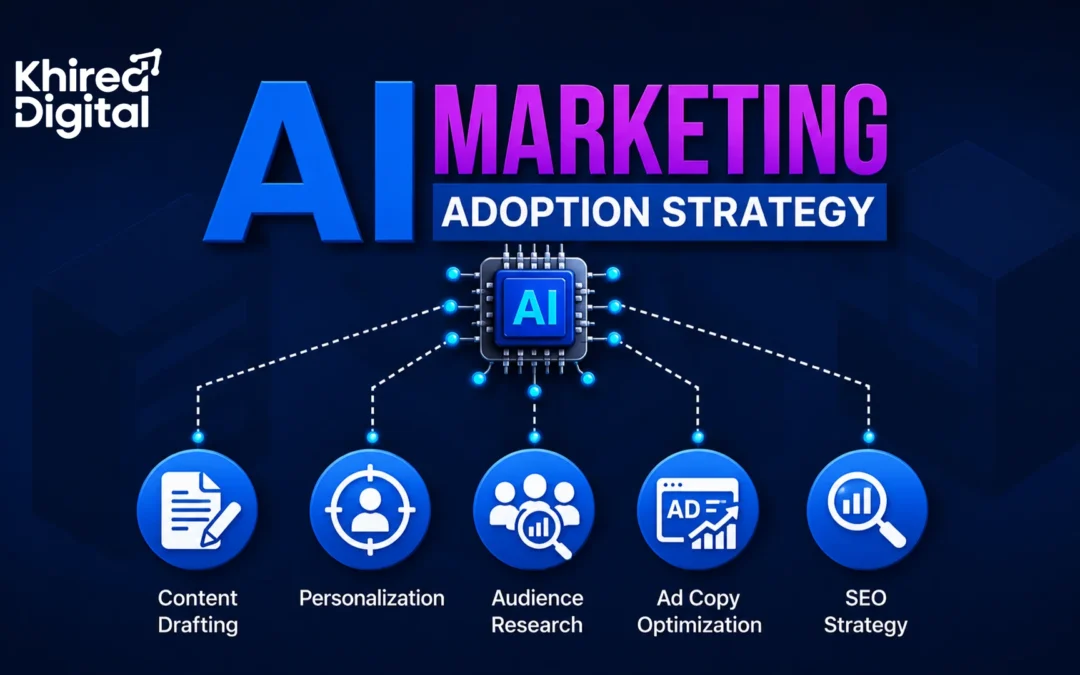
- Content drafting delivers the highest AI ROI at 4.1x; personalisation engines deliver 2.7x; audience research 2.4x; ad copy 2.3x (McKinsey Global AI Survey)
- Marketers save an average of 6.1 hours per week through AI tools — senior practitioners save 8–10 hours (HubSpot AI Trends, 2026)
- Median payback on AI marketing tool investment is now 4.2 months, down from 7.8 months in 2024 (Digital Applied, 2026)
- 45% of marketing teams report GenAI is causing confusion within their teams — adoption without a strategy is the most common implementation failure (Gartner, 2025)
- 74% of companies struggle to achieve and scale value from AI initiatives (BCG) — the tool is rarely the problem; the strategy and measurement framework almost always are
91% of marketers now use AI in some part of their workflow. Enterprise teams have reached 87% adoption. Even small teams have crossed 50%.
But here is the number that matters most: only 41% of marketers can actually prove AI ROI, down from 49% the year before — despite adoption jumping from 63% to 91% over the same period (Jasper, 2026).
Teams adopted AI faster than they built the measurement frameworks to understand whether it was working. The result is that most businesses are using AI in marketing, but most cannot tell you with any precision whether it is improving their outcomes or just changing how they fill their working day.
This guide is for businesses at any stage of AI marketing adoption — from teams that have not started yet to teams that have adopted several tools but are not seeing the returns they expected. It covers the most effective applications, the real ROI benchmarks, the adoption roadmap that actually works, and the most common mistakes that derail implementations before they create value.
The State of AI Marketing in 2026
Understanding where the market stands gives you a clearer picture of where your business sits relative to peers — and where the real opportunity lies.
Adoption Is Near-Universal — But Shallow for Most
The Salesforce State of Marketing series tracks GenAI recurring workflow adoption across the same question three years running:
- Q1 2024: 51%
- Q1 2025: 76%
- Q1 2026: 87%
That is the most reliable longitudinal dataset on AI marketing adoption available. The direction is clear. The nuance is what “adoption” means in practice. At most organisations, adoption means one or two people using a ChatGPT subscription to help with copy — not a systematic, measured AI marketing programme. GenAI is used for marketing activities an average of just 15.12% of the time across the organisations surveyed (CMO Survey, Spring 2025).
The Gap That Defines 2026
34% of enterprise marketing teams now run at least one autonomous AI agent in production (Digital Applied, 2026). Only 19.2% have deployed AI agents for full end-to-end campaign automation (HubSpot, 2026).
The gap between the 91% who have “adopted AI” and the 19.2% who are running autonomous campaign systems is where the next competitive divide is forming. Businesses that move from individual tool adoption to integrated AI marketing programmes in 2026 will compound advantages that later adopters will struggle to close.
AI Marketing Statistics at a Glance (2026)
| Metric | Figure | Source |
|---|---|---|
| Marketers using AI | 91% | Jasper, 2026 |
| Enterprise adoption rate | 87% | State of AI Marketing, 2026 |
| Small team adoption rate | 50%+ | State of AI Marketing, 2026 |
| Average marketing budget on AI | 18% | State of AI Marketing, 2026 |
| Marketers who can prove AI ROI | 41% | Jasper, 2026 |
| Average hours saved per marketer per week | 6.1 hours | HubSpot AI Trends, 2026 |
| Median payback on AI marketing investment | 4.2 months | Digital Applied, 2026 |
| Teams reporting positive ROI within 6 months | 71% | Gartner, 2025 |
| Teams reporting AI causes internal confusion | 45% | Gartner, 2025 |
| AI-driven campaigns vs traditional campaigns ROI | +22% | Semrush, 2026 |
| Average revenue increase from AI implementation | +41% | AISofto, 2025 |
| Marketing cost reduction from AI adoption | -37% | Sopro, 2026 |
| Customer engagement boost from AI | +55% | Sopro, 2026 |
Where AI Delivers Real Marketing ROI
Not all AI marketing applications return equally. Knowing which applications deliver the strongest returns tells you where to start and where to concentrate your budget.
High-ROI Applications (Invest Here First)
Content drafting and production — 4.1x ROI: Content creation consistently delivers the highest AI marketing ROI. Blog posts, email copy, social media content, product descriptions, ad variants — AI tools produce first drafts in seconds that human writers refine and approve. The model that works is not “AI writes, no humans involved” but “AI drafts, humans edit and approve.” Teams using this pattern produce 42% more content per month on average (Averi, 2026) with significantly less headcount growth.
The platforms most widely used: ChatGPT, Claude, Gemini, Jasper, Copy.ai for copy; Midjourney, DALL-E, Adobe Firefly for images; HubSpot AI, Canva AI for integrated marketing creation.
Personalisation engines — 2.7x ROI: AI personalisation — serving each customer a uniquely relevant version of your email, website, or ad creative based on their behaviour, preferences, and stage in the buyer journey — delivers 2.7x ROI across enterprise deployments (McKinsey). This is where the enterprise advantage compounds: personalisation scales better against large customer bases than content drafting does. The larger your audience, the more relative value AI personalisation provides.
Platforms: Dynamic Yield, Salesforce Marketing Cloud, HubSpot Smart Content, Adobe Target, Klaviyo AI.
Audience research and segmentation, 2.4x ROI: AI tools analyse customer data, purchase history, behavioural signals, and third-party data to identify audience segments that manual analysis misses — and to update those segments in real time as behaviour changes. What used to require a data analyst running weekly reports now happens continuously and automatically.
Ad copy optimisation, 2.3x ROI: AI-assisted ad copy generation and A/B testing significantly increases the volume of copy variants tested, which directly improves click-through rates and conversion rates. Google’s Performance Max and Meta’s Advantage+ both use AI to optimise ad creative and targeting automatically. Teams running AI-assisted paid search and paid social report a 22% better ROI than those using traditional campaign management (Semrush, 2026).
Medium-ROI Applications (Build Toward These)
Email marketing automation: AI-powered send time optimisation, subject line testing, and dynamic content personalisation deliver consistent uplift over standard email automation. Not the highest individual ROI on this list, but the combination of high volume and low incremental cost makes email AI one of the fastest payback applications.
SEO and content strategy AI tools for keyword research, content gap analysis, SERP research, and content brief generation accelerate the research phase of content production. Semrush AI, Ahrefs AI, and tools like Clearscope and Surfer SEO are standard infrastructure for content teams producing at any meaningful scale in 2026.
Social media management: 89.7% of social media marketers use AI daily or several times a week for analytics, content ideation, and scheduling (Sociality.io, 2026). Scheduling, caption generation, hashtag research, performance analysis, and trend identification are all highly suited to AI automation — they are repetitive, data-driven, and time-consuming without AI.
Customer service and chatbots: AI chatbots handling customer enquiries across website and messaging channels are among the most mature and well-proven marketing AI applications. For businesses where customer service is a significant part of the marketing experience, this delivers both direct cost savings and measurable customer satisfaction improvement.
Lower-ROI Applications (Use With Caution)
AI video generation — 1.1x–1.6x ROI: AI video tools deliver significantly lower returns than other AI marketing applications despite the hype. Production overhead remains high even when generation is automated. The quality of AI-generated video for professional marketing contexts is not yet at a level where it replaces human-produced content for most businesses. Useful for specific formats (social shorts, explainer animations) but not a high-priority investment for most organisations in 2026.
Fully automated social content without human review: Teams that remove human review from AI-generated social content consistently produce lower-engagement content and occasionally produce content that damages brand reputation. The time saving is real; the quality cost is also real. Human review before publishing is not optional at this stage of AI development.
The AI Marketing Adoption Roadmap
Most businesses fail at AI marketing adoption not because the tools are wrong but because they try to adopt too many tools simultaneously without a measurement framework. This roadmap is structured to prevent that failure mode.
Phase 1: Foundation (Months 1–3)
Goal: Prove value on one use case with measurable results before expanding.
The most common AI marketing failure pattern: a team adopts 12 tools in month one, none of them deeply, and six months later cannot attribute any business outcome to any specific tool. Do not do this.
What to do in Phase 1:
Pick one application from the high-ROI list. Content drafting is the most accessible starting point for most teams — it requires no new data infrastructure, no CRM integration, and delivers visible results within days.
Run it for 90 days against a clear metric. Not “we used AI more” — a business metric. Content output volume. Time to first draft. Cost per piece of published content.
Define your measurement framework before you start. Jasper’s finding that only 41% of marketers can prove AI ROI is almost entirely explained by teams that adopted first and measured later. Measurement is easier to retrofit in weeks one and two than in month five.
Phase 1 tool focus:
- AI writing assistant (Claude, ChatGPT, Jasper, or HubSpot AI built into your existing platform)
- AI image generation (Canva AI, Adobe Firefly, or Midjourney) if you produce significant visual content
- Nothing else until Phase 1 is generating measurable results
Phase 1 success criteria:
- At least one measurable improvement in a content metric
- Team comfortable with AI in daily workflow
- Clear ROI calculation for the Phase 1 application
Phase 2: Expansion (Months 4–8)
Goal: Add two to three AI applications based on Phase 1 learnings; build integration between tools.
Once content AI is embedded and measurable, expand into the next highest-priority application for your business. For most teams, this is either email personalisation or paid ad optimisation — both because they sit adjacent to content production and because they have shorter feedback loops that make measurement straightforward.
Phase 2 tool focus:
- Email AI (built into Mailchimp, Klaviyo, HubSpot, or Salesforce)
- Paid search AI (Google Performance Max, Meta Advantage+)
- SEO AI (Semrush AI, Ahrefs, Surfer SEO)
Critical Phase 2 action: Connect your AI tools to each other and to your CRM. The most significant limitation of early AI marketing adoption is disjointed data — 81% of marketers say they would trust AI to respond to customers at scale but are blocked by disconnected data systems (Salesforce, 2026). Integrated data is what separates tool-level adoption from programme-level adoption.
Phase 2 success criteria:
- Three or more AI applications running with defined metrics
- AI tools connected to customer data (CRM, email list, ad platform audiences)
- Measurable improvement across at least two distinct marketing functions
Phase 3: Integration (Months 9–18)
Goal: Move from individual AI tools to connected AI marketing infrastructure.
This is where most businesses plateau. They have multiple AI tools, each working individually, none informing the others. Phase 3 is about connecting the data, the workflows, and the measurement into a coherent AI marketing system.
What Phase 3 looks like in practice:
- Audience segments from your CRM automatically feed your ad targeting, your email personalisation, and your content recommendations
- Performance data from campaigns automatically informs content production priorities
- Customer behaviour signals update segmentation in real time
- Reporting consolidates AI-influenced metrics across all channels
Phase 3 tool consideration: Platform consolidation. Running 15 individual AI marketing tools creates integration overhead and measurement fragmentation. Phase 3 is the moment to evaluate whether consolidating into a platform (HubSpot AI, Salesforce Marketing Cloud, Adobe Experience Cloud) reduces complexity without losing capability.
Phase 4: Agentic Marketing (Month 18+)
Goal: Deploy AI agents that execute marketing workflows autonomously with human oversight at decision points.
34% of enterprise marketing teams now run at least one autonomous agent in production (Digital Applied, 2026) — more than double the 14% in Q4 2025. The growth is fast. The early adopter window is closing.
Agentic marketing means AI systems that do not just generate content or suggest actions but execute multi-step marketing workflows: monitor performance, identify issues, generate content variants, run tests, and adjust targeting — all within defined parameters, with humans reviewing outcomes rather than managing each step.
Salesforce’s internal Agentforce deployment resolved 83% of customer service queries autonomously with no human escalation — one of the most concrete published examples of what agentic marketing infrastructure produces at scale.
What agentic marketing looks like for most businesses:
- An AI agent monitors your paid search campaigns and adjusts bids automatically within set parameters
- An AI agent identifies low-performing email segments and generates personalised re-engagement sequences for human approval
- An AI agent monitors your brand mentions and surfaces engagement opportunities for your social team to act on
- An AI agent generates weekly content briefs based on SEO performance data, competitor gap analysis, and your editorial calendar
The Four Biggest AI Marketing Adoption Mistakes
Mistake 1: Adopting Tools Without a Measurement Framework
Jasper’s finding that only 41% of marketers can prove AI ROI despite 91% adoption tells you everything. Adoption without measurement is not an AI strategy — it is an AI expense. Before adopting any AI tool, define: what metric will improve if this works, and by how much, over what timeframe?
Mistake 2: Starting with the Most Complex Application
Teams that begin their AI marketing adoption with personalisation engines or agentic campaign automation are starting at the wrong end of the complexity spectrum. Start with content drafting. It is the highest ROI, the lowest implementation risk, the fastest to show results, and the best way to build AI fluency in your team before tackling more complex applications.
Mistake 3: Removing Human Review Too Early
45% of marketing teams report GenAI is causing confusion (Gartner, 2025). In most cases, the confusion stems from AI-generated content going out without adequate human review — inconsistent brand voice, factual errors, occasionally embarrassing outputs. The time saving from removing human review is real. The brand risk is also real. The correct model is AI-assisted production with human approval at the publish gate — not full automation until you have built confidence in a specific AI application over a long enough track record.
Mistake 4: Treating AI as a One-Person Responsibility
The most successful AI marketing implementations in 2026 are team-wide, not owned by one person who is “the AI person.” Building AI literacy across the marketing team — 54% of teams report team training as a top challenge (State of AI Marketing, 2026) — is a prerequisite for scaling beyond individual tool use to a connected AI marketing programme. If only one person knows how to use the tools effectively, the organisation has a key-person risk, not an AI capability.
AI Marketing ROI: What to Measure and When
The most important measurement principle: define success metrics before adopting any tool, not after.
Metrics by Application
| AI Application | Primary Metric | Secondary Metric | When to Expect Results |
|---|---|---|---|
| Content drafting AI | Content output volume, cost per piece | Engagement rate, SEO ranking improvement | 30–60 days |
| Email personalisation | Open rate, click rate, conversion rate | Revenue per email send | 60–90 days |
| Paid ad AI | CPC, ROAS, conversion rate | Cost per lead or acquisition | 30–60 days |
| SEO AI | Organic traffic, keyword ranking movement | Content production volume | 90–180 days |
| Social media AI | Engagement rate, follower growth | Brand awareness metrics | 30–60 days |
| Chatbot / customer service AI | Resolution rate, CSAT score, handling time | Cost per resolved query | 60–90 days |
| Personalisation engine | Click-through rate, time on site, conversion rate | Revenue per visitor | 90–120 days |
The ROI Calculation Framework
Step 1: Establish your baseline before implementing any AI tool. Document your current content output volume, cost per piece, hours spent, engagement rates, and conversion metrics.
Step 2: Assign a cost to the AI tools: licence fee + integration time + training time + ongoing management time.
Step 3: Measure the delta after 90 days: hours saved × employee hourly cost + improvement in target metric × its commercial value.
Step 4: Calculate ROI: (Value of gains − Cost of AI tools) ÷ Cost of AI tools × 100.
The teams that report 3.2x ROI are not measuring this differently from the teams that report “we’re using AI but can’t prove it’s working.” They are measuring the same things — they just committed to the measurement framework before adoption.
AI Marketing for Different Business Sizes
Small Businesses (Under 20 Employees)
Content drafting is your highest-priority starting point. A single AI writing tool that helps produce consistent blog content, social captions, and email copy saves 4–6 hours per week — the equivalent of adding half a day of capacity per marketer.
Starting toolkit:
- Writing: Claude.ai or ChatGPT Plus ($20/month each)
- Design: Canva with AI features (free tier sufficient for basic use)
- Email: Mailchimp with AI subject line and send-time features (included in paid plans from $13/month)
- Social: Buffer or Hootsuite with AI caption assistance
Total entry cost: $50–$100/month. Payback on time savings alone within 2–4 weeks.
Mid-Market Businesses (20–200 Employees)
Integration between tools is the priority gap for most mid-market businesses. Individual AI tools are typically already in use; the value is in connecting them to customer data and measuring outcomes across the full funnel.
Priority investments:
- CRM with AI features (HubSpot Marketing Hub, Salesforce Marketing Cloud)
- AI-powered SEO platform (Semrush, Ahrefs)
- Email personalisation layer connected to CRM
- Paid media AI optimisation (fully leverage Google Performance Max and Meta Advantage+)
Enterprise Businesses (200+ Employees)
At enterprise scale, the strategic question shifts from tool adoption to AI programme governance. 77% of marketers using GenAI say they use it for creative development tasks (Gartner), but only 19.2% have AI running autonomous campaign workflows. The opportunity is moving from task-level assistance to programme-level automation.
Enterprise priorities:
- AI content operations platform (Jasper Enterprise, Writer, or built on top of HubSpot/Salesforce)
- Personalisation engine integrated with CDP (Customer Data Platform)
- Marketing analytics AI for attribution and performance insight
- Governance framework: brand voice guidelines, content review processes, AI usage policies
- Agentic marketing infrastructure for the highest-volume, most-repetitive marketing workflows
Building an AI Marketing Team
The skills required to run an effective AI marketing programme in 2026 are different from the skills required five years ago.
Skills that have increased in value:
- AI prompt engineering and tool configuration
- Data interpretation and analytics
- Editorial judgment and brand stewardship (what to approve from AI output)
- AI workflow design and automation
- Strategy, creative direction, and storytelling
Skills where demand has shifted:
- Junior copywriting (23% of agencies reduced junior copywriting headcount in 2025; 31% plan further cuts in 2026 — Gartner CMO Spend Survey)
- Manual data collection and reporting
- Repetitive content production
The most important team capability in 2026 is not knowing which AI tools to use — it is knowing how to evaluate AI output, improve it quickly, and build workflows that consistently produce on-brand, accurate content at scale. This is the editorial and strategic capability that separates high-performing AI marketing teams from those that produce high-volume mediocre content.
How Khired Digital Can Accelerate Your AI Marketing Adoption
Moving from individual AI tools to a connected, measurable AI marketing programme is the transition most businesses struggle with. The gap between tool adoption and programme maturity is where most AI marketing investment stalls.
Khired Digital builds AI-integrated marketing strategies, social media programmes, and content operations for businesses across Pakistan, the UK, and internationally — combining the strategic thinking to identify where AI creates real leverage in your specific situation with the execution capability to build and manage the systems that deliver measurable results.
Whether you are starting your AI marketing adoption, trying to prove ROI on tools you are already using, or building toward autonomous AI marketing infrastructure — contact Khired Digital to discuss your programme.
Frequently Asked Questions
What is AI marketing adoption and why does it matter?
AI marketing adoption is the process of integrating AI tools and systems into your marketing operations — from using AI to draft content faster, to running autonomous agents that manage campaign workflows. It matters because marketing teams using AI effectively produce more content, reach audiences more precisely, convert more efficiently, and do all of it at lower cost. Companies using AI for marketing report a 37% reduction in marketing costs and a 41% average revenue increase (AISofto/Sopro, 2026). Teams that do not adopt face a compounding disadvantage as competitor teams produce more, target better, and personalise at scale.
Which AI marketing tool should I start with?
For most businesses, an AI writing assistant is the correct starting point. Claude.ai, ChatGPT Plus, Jasper, or HubSpot’s built-in AI writing features all deliver fast, measurable results — more content produced, faster first drafts, lower cost per published piece. Content drafting AI delivers 4.1x ROI on average (McKinsey), the highest of any AI marketing application. Start there, measure the results, and expand to your next priority application once you have baseline data.
How do I measure ROI from AI marketing tools?
Establish your baseline metrics before implementing any AI tool. For content tools: current cost per piece, hours spent, and output volume. For ad tools: current CPC, ROAS, and conversion rates. For email tools: current open rates, click rates, and revenue per send. Measure the same metrics after 90 days. Calculate ROI as (value of measurable gains minus cost of AI tool) divided by cost of AI tool. Teams that measure this way consistently find 2x–4x returns; teams that measure without a baseline consistently cannot prove any return.
Is AI marketing suitable for small businesses?
Yes — small businesses can access meaningful AI marketing capability for $50–$100/month. Entry-level AI writing tools (ChatGPT Plus, Claude.ai), AI-assisted email platforms (Mailchimp, Brevo), and AI social tools (Buffer, Canva) are affordable for businesses of any size. Small business adoption has crossed 50% in 2026. The question is not whether small businesses can use AI — it is whether they are using it systematically enough to see the returns that the data shows are available.
What are the risks of AI in marketing?
The main risks are brand consistency (AI can produce off-voice content at scale if not reviewed), accuracy (AI can hallucinate facts, statistics, and quotes), customer trust (customer trust in businesses using AI ethically has declined from 58% in 2023 to 42% in 2026, per Salesforce), and team confusion (45% of marketing teams report GenAI causes internal confusion). All of these risks are manageable with human review processes, clear AI usage policies, and a deliberate adoption strategy. They are not reasons to avoid AI marketing — they are reasons to implement it thoughtfully.