
WhatsApp
What Are the 4C’s of Marketing? Definition & Examples

What Are the 4C’s of Marketing? Definition & Examples

The process of scrolling through Instagram leads you to discover an impressive advertisement that promotes a new smartwatch. The advertisement does not provide detailed information about the product’s technical specifications or its purchasing locations but instead poses the question, “Tired of missing important calls while cycling?” 

The advertisement employs contemporary customer-focused marketing methods, which base its structure on the 4C’s of marketing instead of traditional advertising techniques. The framework enables businesses to view all aspects through their customers’ perspectives.

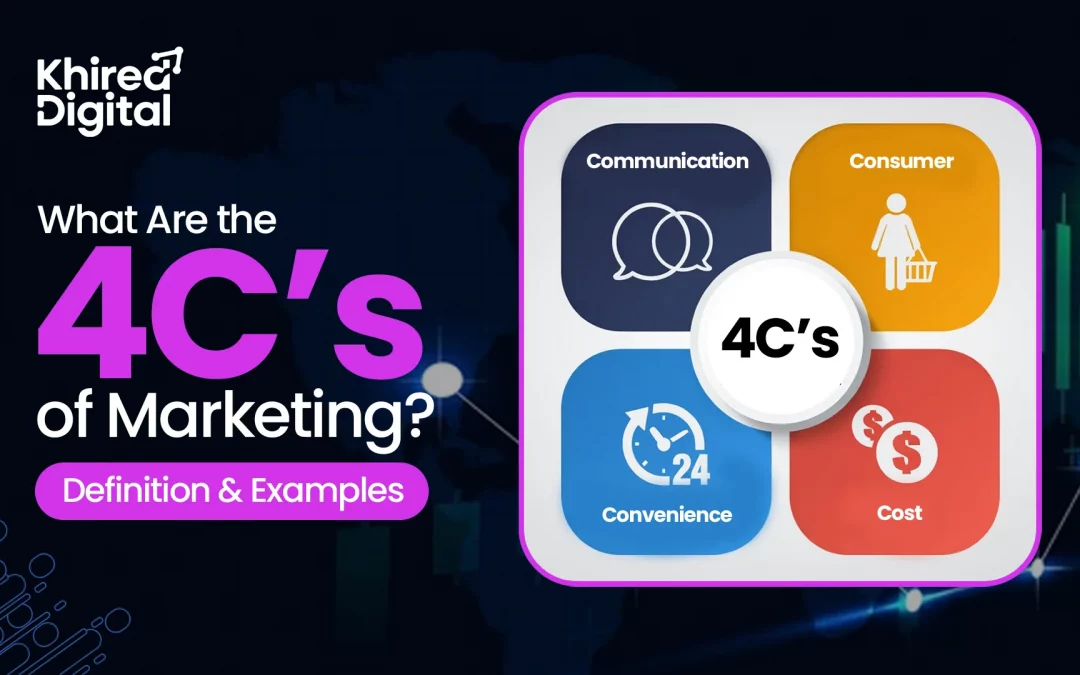
The 4C model, consisting of customer, cost, convenience, and communication, has become essential for businesses that want to create successful campaigns. It builds customer relationships in the current digital environment, where customers have complete control.

This blog highlights the 4Cs of marketing along with examples.

So, let’s start.

4Cs of Marketing

Discussed here is the detailed analysis of the 4Cs of marketing:

1. Customer: Solve Their Problem, Don’t Just Sell Your Thing

The first C changes attention away from the product and toward the customer. Rather than wondering what we are selling, you query what problem your customer needs to address. Your product or service is just the answer. 

A good website builder is the customer’s wish for a professional online presence without having to code; it is not merely technology. A meal-kit delivery service is the customer’s requirement for quick, nutritious meals that save time, not a box of components.

Example: A SaaS company doesn’t present a list of features at first. On its homepage, it states, “Stop wasting hours on manual reports. Create Ideas in a Few Minutes.” The product is presented solely as the answer to the customer’s particular problem.

2. Cost: It’sMore Than Just Money 

The second C expands the price into the overall cost. Price is only the monetary amount; cost covers all that the customer gives up getting your product. This encompasses the time invested in becoming proficient in using your product, the mental strain of a challenging sign-up procedure, and the risk of selecting you instead of a rival. Reducing the non-financial expenses is your aim; increasing seen value is your direction.

Example: A virtual retailer provides simple, no-hassle returns within 100 days. This greatly lowers the client’s risk cost impression. By removing the financial cost barrier and enabling consumers to spend time learning the platform risk-free, a project management tool provides a strong free-forever plan.

3. Convenience: Be Wherever and Whenever They Are

The third C turns place into convenience. Making the purchasing process simple is more important than simply having physical or virtual shelf space. Could the customer find you on the social network they use most? Are they capable of buying with two clicks from their smartphone? Is your website at lightning pace? In digital marketing, convenience means eliminating every little obstacle.

Example: Instagram Shopping tags let customers buy the outfit they see in a reel without exiting the app. Eliminating the need for long email threads, a B2B service has a “Book a Demo” calendar widget directly on its price page. This is convenience in action.

4. Communication: Two-Way Dialogue, Not One-Way Broadcast

The last and most important C transforms promotion—a one-way broadcast—into two-way dialogue, communication. Designed for interaction, not just notification, are digital channels. This means commenting, replying to DMs, using social listening to follow discussions about your brand, and generating material that encourages interaction—polls, Q&As, and user-generated content initiatives.

Example: A company won’t only release a fresh product launch video. It sponsors a live YouTube Q&A with its product creators and tweets a Twitter thread looking for feature wishlists. Also, it proactively replies to every comment with tailored responses. This generates trust and community far beyond any conventional advertisement.

What is the Difference Between 4Ps and 4Cs of Marketing?

The difference is a fundamental shift in perspective, crucial for the digital age. The 4Ps represent the seller’s viewpoint—the tools the marketer controls. The 4Cs represent the buyer’s viewpoint—the experience the customer values. The 4Cs don’t make the 4Ps obsolete; they modernize them. A customer-centric (4C) strategy informs how you develop your product, set your price, choose your place, and execute your promotion.

4P’s (Brand’s View) 

4C’s (Customer’s View) 

Core Question for Digital Marketers 

Product 

Customer 

What solution does my audience truly need? 

Price 

Cost 

What is the total cost (money, time, and effort) to my user? 

Place 

Convenience 

How can I make the journey frictionless? 

Promotion 

Communication 

How can I start a conversation, not just send a message? 

Final Thoughts 

The 4C’s of marketing deliver essential customer-centric perspectives, which organizations need to succeed in the current digital business environment. Your business needs to focus on solving customer problems while maintaining low operational expenses, creating easy access points for all contact moments, and establishing authentic communication channels. 

Your framework will deliver digital content that people can see as valuable content while your digital assets achieve optimal reach and engagement. Your marketing becomes a direct invitation to your audience through this approach. 

Ready to build a digital marketing strategy that puts your customer at the heart of every campaign? Khired Digital works as our strategic partner. Let’s apply the 4C’s to expand your brand presence while building your community and achieving greater success.


Frequently Asked Questions

Should I use the 4Ps or the 4Cs for my digital strategy?

You must begin with the 4Cs because both methods need to be executed. The 4C framework helps you understand your customer needs and their product experience. The 4Cs explain the reason for existence, while the 4Ps describe the method of implementation.

Which 'C' is the most important in digital marketing?

People find the process of communicating through digital channels demands more effort, yet needs digital platforms enable brands to establish trust through authentic two-way communication. It builds stronger relationships with their audience while providing them with real-time feedback that boosts their three C’s performance.

Can the 4Cs be applied to a service-based business?

Absolutely. In fact, they are often more relevant. For a digital marketing agency: Customer = The client’s growth goals. Cost = The agency’s fee + the client’s time in meetings. Convenience = Easy onboarding, clear reporting dashboards. Communication = Regular strategy calls and transparent updates.
Exploring Sales and Marketing Duties and Responsibilities

Exploring Sales and Marketing Duties and Responsibilities

Companies with strong sales & marketing alignment are 67% better at closing deals than less-aligned firms.

You walk into a store for a new phone. A nice sales representative walks toward you to ask rather than to push the latest expensive model. He asks what you might need: was it camera quality, battery life, or price? He guides you to the right product and makes sure you are satisfied with your decision.

On your way home, scrolling through Instagram, you see an ad for affordable smartphones that describes precisely your interests. This seamless experience ties in a helping hand in sales to an advertising campaign, a visual representation of the invisible collaboration of sales and marketing.

Sales and marketing, often regarded as separate worlds, are but two faces of the same coin. Together they create growth, nurture relationships, and keep a company going. Let’s look at what sales and marketing are about and what responsibilities and duties flow from these roles in a dynamic marketplace, which will assist us in understanding their impact.

What Is Sales?

Sales stands for a direct way of converting prospects into customers. It involves developing trust, understanding customer needs, meeting them with potential solutions, and completing the deal. The salesperson is a representative of the company; that is, the person customers interact with right before they make their decision.

Their work goes beyond transactions; it’s about creating experiences that make customers come back.

What Is Marketing?

Marketing is the wider strategy encompassing all sales. It includes research, planning, communication, and campaigns that include things such as customer attraction, customer information, and customer engagement.

Thus, marketing is staging the whole scene so that sales can shine upon it. From their social media content, digital ads, product packaging, and brand storytelling, marketing makes sure customers know, like, and trust a company before the customer meets with any salesperson.

Sales Duties and Responsibilities

Sales work often consists of the directive of goals and always focuses on the customer. Their jobs combine persuasive understanding and a problem-solution presentation. Here are some core responsibilities explained with practical examples:

1. Prospecting and Lead Generation

Salespersons look out for prospective clients through cold calling, networking, referrals, or LinkedIn outreach.

Example: A sales professional promotes a software house by ushering in small businesses in DHA Lahore for free demonstrations on their CRM systems.

2. Understanding Customer Needs

Great salespeople know what questions to ask to find those pain points.

A salesperson would know that he should not pitch an expensive laptop, since the customer needs a system primarily just for graphic design work, and now he is recommending the appropriate mid-range model with great processing power.

3. Product Presentation and Demonstrations

The sales rep does the demonstration of the product or services to the customers while explaining the benefits of using it.

Safety features on the car will help parents know how the vehicle protects them during test drives.

4. Negotiation and Closing Deals

Sales in the economy will generally balance between pricing by the company and the customer.

The salesperson can be a little generous with discounts when very high-volume orders come for a company setting up.

5. Maintenance of Customer Relations

Sales do not end at purchase; after-purchase service is also part of sales.

A real estate agent stops by six months after the sale of a house to see that the family is satisfied and open the possibility of referrals.

6. Achieving Sales Targets

Measurement of the salespersons is through monthly quotas or targets.

A telephone service representative is to sign up 50 people every month. Attaining this goal earns bonuses and recognition.

Marketing Duties and Responsibilities

It is a little strategic and very research-driven. Responsibilities are lines of building a very long brand presence, while marketing ensures sales lead generation. Let us walk through those examples uniquely:

1. Market Research and Analysis

Marketers examine consumer behavior, competition, and market trends.

A clothing retailer surveys customers and discovers that its consumers in Lahore prefer sustainable fabrics, prompting the retailer to launch an eco-friendly clothing line.

2. Developing Campaigns

Jingles, digital ads, or traditional billboards? Campaigns spread messages to customers.

A new coffee shop generates some buzz through TikTok reels with local influencers to promote their specialty lattes, making the café the place to be.

3. Content Development

Marketing teams can create blogs, videos, newsletters, and social media posts.

A software company shares tutorials on YouTube showing small businesses how easy it is to manage their invoices. Hence, elevating their status as experts and trusted resources.

4. Brand Oversight

Marketers protect or enhance the brand’s reputation.

During a product recall, the marketing team for a food company gives regular updates to the public and reassures consumers they are committed to safety and transparency.

5. Leads that Equal Sales

Marketing generates interest, while the sales team converts the interest.

A specific real estate marketing campaign has targeted Facebook ads called “Virtual Tours of DHA Villas,” with the intent of capturing the contact information for the sales team.

6. Evaluating Campaign Performance

Marketers measure clicks, conversions, and engagement to improve their campaigns.

A digital marketing agency realizes Instagram ads bring 70% more leads than Google Ads and reallocates budget accordingly.

How Sales and Marketing Work Together

Organisations where sales and marketing are well aligned achieve up to 208% more return on marketing investment — and much faster revenue growth.

Sales and marketing are both powerful, but when combined they create a growth engine for businesses. For example, marketing introduced a potential customer to the business using a compelling email campaign. Next, sales closed the deal and had a successful conversation with the potential customer that personalized the company offering.

A software company launched a marketing campaign on “Why Small Businesses Ultimately Need to Take CRM.” Marketing collected emails through a free eBook, and then the sales team followed with a personalized communication demo to turn these warm leads into clients.

This coordinated approach provides the customer with the best experience possible along their journey from awareness to decision-making.

Why These Roles Matter More Now

In an increasingly competitive market, today’s customers are more educated than they have ever been. Customers essentially compare products and see how companies treat their customers through their online presence.

For that reason, sales and marketing roles are now relationship-building functions as opposed to just one-way communication. Companies that have a strong sales team and creative marketing team set themselves apart from everyone else, win trust, and generate loyalty.

Final Thoughts

Sales and marketing may have separate functions, but they are the foundation of every successful organization. Sales develops personal relationships and finalizes deals, whereas marketing builds the broader brand and creates opportunities for people to engage the brand.

Skills like negotiating and assessing the customer’s needs mingle with characteristics like creating engaging campaigns for people and managing a brand’s reputation to successfully create the business. Thus, fuelling the growth of those businesses.

In essence, marketing garners attention, and sales earns relationships. Both functions working together allow the business to grow rather than just survive.


Frequently Asked Questions

What is the main difference between sales and marketing duties?

Marketing focuses on awareness, creates leads, and builds brand reputation, and then sales converts that new business or lead into customers with the intention to buy through selling.

Why are sales and marketing responsibilities often linked together?

Because both functions rely on each other—marketing attracts potential buyers, and sales turn them into clients. Together, they enhance business growth.

Do small businesses need separate sales and marketing teams?

Not always. In many startups, one team or even a single person handles both roles. As the business grows, separating them improves efficiency and results.

Direct Marketing vs Advertising: A Complete Guide

Direct Marketing vs Advertising: A Complete Guide

The vast and quick-spinning wheel of marketing has caught up in certain perpetual dilemmas: direct marketing or advertising?  

Though both share the same purpose, that is, the marketing of a product or service. Still, the two vary in approach, implementation, expense, and expected outcome.

Knowing the differences, however, is significant in creating campaigns that can reach the target audience and bring quantifiable results.

Each method is explained in this guide, helping you to select the best method for your objectives and budget. 

What is Direct Marketing? 

Direct marketing is a form of promotion where companies reach out to their prospective customers directly by means such as email, SMS, mail, or telemarketing. The goal is that there should be an instant reaction or action, such as buying something, enrolling in a newsletter, or browsing a website.

For example, a special email to a customer on his birthday from an apparel company with a 25% discount. This will lead to inducing them to shop within a given period.

Key Features of Direct Marketing

  • Personalized communication based on user behaviour or data
  • Segmented communication with targeted audiences
  • Can be easily tracked and measured ROI through sources like Google Analytics or CRM software
  • Prompts an instant response, e.g., a click, a reply, or a buy
  • Generally cheaper for small and startup companies

What is Advertising? 

Advertising is a broad promotional method that uses mass media (print, television, outdoor signage, and digital media advertisements) to convey a message to a large audience. The main objective is to create brand awareness, influence perceptions, and reach out to as big of an audience as possible in the long term.

Example: A telecommunication company broadcasts a TV ad in prime time advertising its new 5G network to a national audience with a view to enhancing brand reputation and consumer confidence.

Key Characteristics of Advertising

  • Reaches a large and usually undefined segment of people, often with a broad appeal 
  • Centered around brand establishment and recognition
  • Usually more costly due to placement in mass media 
  • More difficult to measure ROI but creates long-term trust and familiarity 
  • Usually deployed for major product rollouts or repositioning of a brand

Direct Marketing vs Advertising: A Detailed Comparison 

Feature 

Direct Marketing 

Advertising 

Audience 

Specific, targeted individuals 

Broad, general public 

Communication Style 

Personalized and direct 

General and broad 

Medium 

Email, SMS, postal mail, telemarketing 

TV, radio, newspapers, digital ads 

Objective 

Immediate response or conversion 

Long-term brand awareness and recall 

Cost 

Cost-effective for smaller campaigns 

Can be expensive due to media placement 

ROI Tracking 

Easy to track using tools and analytics 

Difficult to measure precisely 

Response Time 

Immediate or short-term 

Long-term brand influence 

Engagement 

High engagement due to personalization 

The audience may passively view 

Examples 

Email campaign with a discount code 

Billboard promoting a new car 

When to Use Direct Marketing 

Direct marketing is most effective when the business goal is conversion-based or transactional. Direct marketing facilitates relationship-building and stimulates instant action. 

Ideal Situations

New Product Introductions: Best suited for targeting specific segments with personalized messages, like introducing a technology gadget to technology-friendly users. 

Event Invitations: Invite selected guests based on previous attendance or interest. 

Seasonal Offers: Custom coupons or discounts at holidays or birthdays.

Lead Nurturing: Engaging potential customers with automated email follow-ups or retargeting commercials.

Example: A web-based bookstore emails a list of suggested reading based on a customer’s past purchases, giving a 15% discount if bought in 48 hours. 

When to Use Advertising 

Advertising best serves long-term branding initiatives and mass reach. It is the best option for companies that want to build market presence or inform audiences about new products. 

Ideal Situations 

Brand Building: To build broad awareness and establish long-term recall. 

Product Education: Launching new ideas, like fintech services or health apps. 

Trust & Credibility: Mass media campaigns tend to give authenticity to emerging or new brands. 

Market Penetration: Tapping new markets or geographies by accessing new untapped audiences. 

Example: A soft drink company launches a national ad campaign during the Cricket World Cup to drive visibility, tap emotions, and stimulate brand recall. 

Pros and Cons of Each Strategy 

Direct Marketing 

Pros 
  • Extremely targeted and customizable across various buyer personas 
  • Cost-effective and scalable according to budget 
  • Measurable results directly through click-through rates, conversions, etc. 
  • Two-way communication encourages building customer loyalty 
Cons 
  • May be perceived as intrusive if used excessively (e.g., spam emails) 
  • Needs high-quality and segmented customer database 
  • Exposure limited if not complemented by other channels 
  • Risk of ad fatigue with repetitive messaging to narrow audiences 

Advertising 

Pros 
  • Widespread coverage (Efficient mass reach but with declining attention spans)—can provide millions of impressions 
  • Establishes brand image and long-term trust 
  • Good for introducing new products or repositioning 
Cons 
  • High expense of airtime, print space, or online impressions 
  • ROI more difficult to directly assign unless with use of tracking tools 
  • Lower engagement than with targeted messaging 

Integrating Both for Maximum Impact 

In the present form of omnichannel marketing, the best campaigns join direct marketing and advertising. An organization may possibly do an ad on television or digitally to establish interest in the attraction and then email the personalized offer or conduct a retargeting campaign to close the deal.

For example, a digital marketing agency may start off its SEO advertising campaign via Facebook and YouTube with retargeting emails to website visitors offering free SEO audits or consultations. This gives the combined approach a good balance between reach and relevance.

Choosing Based on Goals

Let’s say a small business in Lahore wants to promote its new skincare product: 

Suppose they wish to ensure that these online sales happen immediately; direct marketing can come by way of SMS campaigns whereby a 10% discount is offered.

On the other hand, brand recognition can be done through ads running on Instagram and YouTube with influencer promotion.

Well, if the budget permits use of both—advertising can generate interest, and direct marketing can capture and convert.

A new app may get advertising on television or on Facebook, together with a targeted email campaign to past customers offering incentives for installation. These efforts create synergy and maximize conversion.

Final Thoughts

There is no winning side when it comes to choosing between direct marketing and advertising; the goal is what did or is going to satisfy the present business needs, audience types, and campaign objectives.  

Direct marketing has a more personalized and cost-effective path to conversions, especially beneficial for small businesses or startups. Advertising, meanwhile, proved to be more expensive, but it invests toward long-term brand investment and trust in the consumer base. 

The secret is using them strategically. Advertising casts a wide net; direct marketing reels them in. When used effectively, this combination creates strong marketing funnels to attract, engage, and convert all buyers.

Whether or not awareness is being built and whether immediate sales or long-term sales are desired, knowing where strong direct marketing vs advertising makes smarter and more powerful campaigns that deliver results in this digital age.

Need help crafting a strategy combining both direct marketing and advertisement? Contact our experts today to supercharge your brand’s growth.