WhatsApp
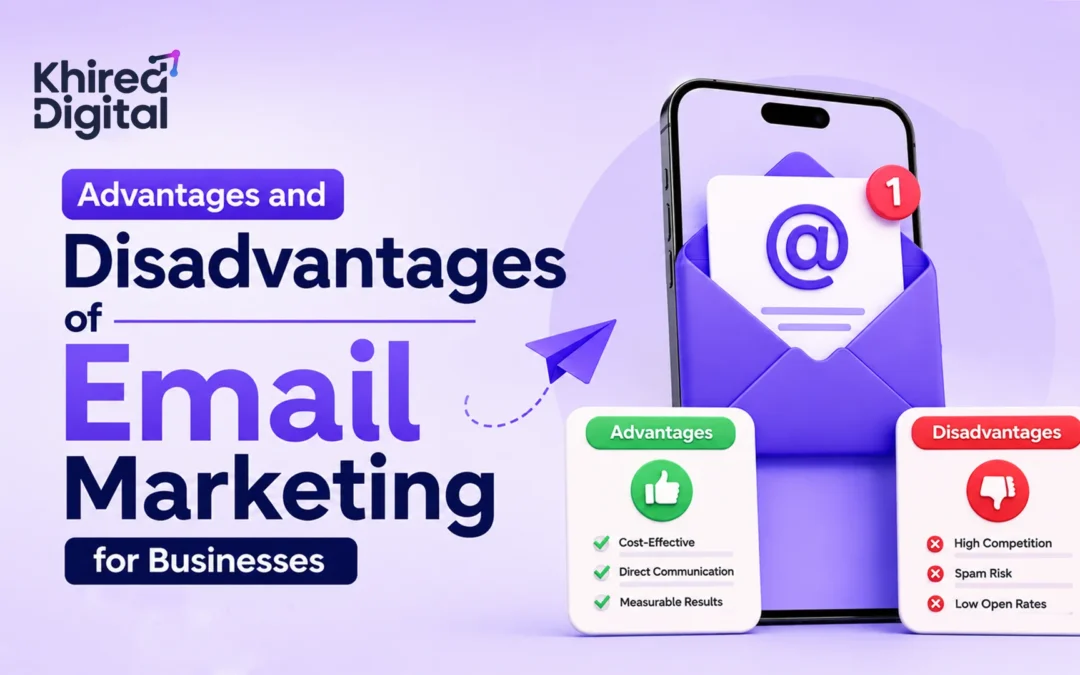
Advantages and Disadvantages of Email Marketing for Businesses

Advantages and Disadvantages of Email Marketing for Businesses

TL;DR
  • Email marketing returns an average of $36–$45 for every $1 spent — the highest ROI of any digital marketing channel (multiple 2025–2026 industry benchmarks)
  • Email is an owned channel — unlike social media, your reach is not controlled by an algorithm that can change overnight and cut your audience access
  • The biggest advantages: high ROI, direct audience ownership, measurability, automation, personalisation, and scalability at near-zero marginal cost
  • The biggest disadvantages: deliverability and spam challenges, list building takes time, privacy regulation (GDPR, CAN-SPAM), inbox saturation, and the need for consistent quality content
  • Apple Mail’s Mail Privacy Protection now affects over half of all email opens — making open rate a less reliable metric than it was and forcing a shift toward click and conversion tracking
  • Email marketing is not a “set it and forget it” channel — the businesses seeing 36:1 to 50:1 ROI dedicate 25–50% of their marketing team’s time specifically to email (Litmus, 2025)
  • Segmented, personalised campaigns dramatically outperform generic blasts — segmented campaigns show up to 760% higher revenue than unsegmented sends (DMA, 2025)

Email marketing generates an average return of $36 to $45 for every $1 spent — a higher ROI than any other digital marketing channel. Around 80% of marketers say they would give up social media before they would give up email. And 99% of email users check their inbox every day, some up to 20 times.

Those numbers explain why email marketing remains a cornerstone of business marketing in 2026, even as newer channels come and go.

But the ROI headline hides a more complicated reality. Email marketing is not equally effective for every business, and it comes with real disadvantages — deliverability challenges, privacy regulation, list maintenance costs, and the constant risk of landing in spam — that the “$42 per $1” statistic conveniently ignores.

This guide gives you the honest picture: the genuine advantages of email marketing, the real disadvantages most articles gloss over, and a clear-eyed view of when email marketing is the right investment for your business and when it is not.

What Is Email Marketing?

Email marketing is the practice of sending commercial messages to a group of people via email — to promote products, share content, nurture leads, retain customers, or drive sales. It ranges from simple newsletters to sophisticated automated sequences triggered by customer behaviour.

The core types of marketing email:

  • Newsletters — regular content updates sent to subscribers
  • Promotional emails — sales, offers, product launches
  • Transactional emails — order confirmations, shipping updates, receipts
  • Automated sequences — welcome series, abandoned cart reminders, re-engagement campaigns
  • Behavioural triggers — emails sent based on specific customer actions

What makes email distinct from every other marketing channel is ownership. When you build an email list, you own the direct connection to your audience. No algorithm decides whether your message reaches them. No platform can cut off your access overnight. That single characteristic underpins most of email marketing’s advantages.

The Advantages of Email Marketing

Advantage 1: The Highest ROI of Any Marketing Channel

Email marketing services consistently deliver the highest return on investment of any digital marketing channel. The average ROI sits between $36 and $45 for every $1 spent, depending on the source and industry.

To put that in context: for every dollar a business invests in email marketing, it earns back $36 to $45. Few marketing channels come close.

The ROI varies significantly by industry:

IndustryAverage Email Marketing ROI
Retail, E-commerce & Consumer Goods$45 per $1 (highest)
Marketing, PR & Advertising$42 per $1
Software & Technology$36 per $1
Professional Services$35 per $1
Large businesses (all sectors)$44 per $1

Email is also 40 times more effective than social media for customer acquisition, according to industry benchmarking data. The reason is structural: email reaches people who have already opted in and expressed interest in your business, which converts far better than broadcasting to a cold social media audience.

Advantage 2: You Own Your Audience

This is the advantage that matters most in 2026. On social media, your reach is controlled by an algorithm. A platform can change its rules overnight and cut your organic reach in half — as many businesses discovered when Facebook, Instagram, and every other social platform reduced organic reach to push paid advertising.

Email is immune to algorithm shifts. Your subscriber list is an asset you own. When you send an email, it goes to the inbox — not to an algorithm that decides whether to show it. This makes email the most reliable channel for reaching an audience you have already built.

This is why around 80% of marketers say they would give up social media before giving up email. Social media reach is rented. Email reach is owned.

Advantage 3: Measurability and Data

Email marketing is one of the most measurable marketing channels available. For every campaign, you can track:

  • Delivery rate (did the email reach the inbox?)
  • Open rate (did they open it?)
  • Click-through rate (did they click a link?)
  • Conversion rate (did they take the desired action?)
  • Unsubscribe rate (did the email cost you subscribers?)
  • Revenue attributed to each campaign

This measurability means you can test, refine, and improve continuously. A/B testing alone can increase email marketing ROI by 83% — businesses that regularly A/B test report an average ROI of 4,200% versus 2,300% for those that never test.

Advantage 4: Automation Saves Time and Scales

Modern email marketing platforms let you automate entire customer journeys. Once set up, these sequences run continuously without ongoing manual work:

  • A welcome series greets every new subscriber automatically
  • An abandoned cart sequence recovers lost sales without human intervention
  • A re-engagement campaign wins back inactive subscribers on a schedule
  • Behavioural triggers send the right message at the right moment based on customer actions

Welcome emails alone achieve open rates as high as 68.6% — far above standard campaign averages — because they reach subscribers at the moment of peak interest. Automation captures that value at scale without proportional effort.

Advantage 5: Personalisation Drives Revenue

Email marketing enables personalisation that most channels cannot match. Beyond using a subscriber’s first name, modern email personalisation includes dynamic content that changes based on each recipient’s behaviour, preferences, and purchase history.

The impact is substantial. Using dynamic content for personalised campaigns raises ROI by 258%. Brands that rarely include dynamic content see an average ROI of 1,200%, compared to 4,300% for businesses that consistently personalise. AI-driven personalisation boosts revenue by up to 41%.

Segmentation amplifies this further — segmented campaigns show up to 760% higher revenue than unsegmented blasts (DMA, 2025).

Advantage 6: Scalability at Near-Zero Marginal Cost

The cost of sending an email to one more subscriber is effectively zero. Whether your list is 500 people or 500,000, the cost per email sent is tiny. This is why email marketing ROI improves as lists grow — the scalability means larger lists produce better ratios.

For a growing business, this is a powerful characteristic. The channel gets more cost-effective the more you invest in building your audience, unlike paid advertising where costs scale linearly with reach.

Advantage 7: Direct, Personal Communication

Email lands in a personal space — the inbox — where people actively spend time. 99% of email users check their inbox every day. Unlike a social media post that competes with infinite other content in a feed, an email sits in the inbox until the recipient deals with it. This gives email a persistence and directness that ephemeral channels cannot match.

The Disadvantages of Email Marketing

An honest assessment requires equal attention to the disadvantages — the challenges that the ROI headlines conveniently skip.

Disadvantage 1: Deliverability and Spam Challenges

The single biggest challenge in email marketing is simply getting your email into the inbox. A significant percentage of marketing emails never reach their intended recipient — they are filtered into spam folders, blocked by email providers, or silently dropped.

Deliverability is affected by:

  • Sender reputation (a history of spam complaints damages it)
  • Email authentication (SPF, DKIM, DMARC records must be configured correctly)
  • Content triggers (certain words and formatting flag spam filters)
  • List quality (sending to invalid or unengaged addresses hurts your reputation)
  • Engagement rates (low open rates signal to providers that your email is unwanted)

A business that neglects deliverability can send thousands of emails that no one ever sees — spending time and money for zero return. Deliverability is a technical discipline in its own right, and getting it wrong undermines everything else.

Disadvantage 2: Building a Quality List Takes Time

You cannot buy your way to a good email list — or rather, you can, but purchased lists are a costly mistake. Bought lists have terrible engagement, damage your sender reputation, and frequently violate privacy regulations.

Building a genuine, engaged email list takes time and consistent effort. You need:

  • A reason for people to subscribe (valuable content, offers, or resources)
  • Sign-up opportunities across your website and channels
  • Ongoing content that keeps subscribers engaged
  • Patience as the list grows organically

For a business that needs results this month, email marketing’s slow list-building phase is a genuine disadvantage. The high ROI is real — but it accrues to businesses that invested in list building months or years earlier.

Disadvantage 3: Privacy Regulation and Legal Compliance

Email marketing is heavily regulated, and the regulations carry real penalties. Businesses must comply with:

  • GDPR (European Union) — requires explicit consent, easy unsubscribe, and data protection
  • CAN-SPAM Act (United States) — requires accurate headers, unsubscribe options, and physical address
  • PECR (UK) — governs electronic marketing communications
  • Local equivalents in every market you email into

Non-compliance can result in significant fines. GDPR penalties alone can reach millions of euros for serious violations. For businesses operating internationally, navigating the different requirements across jurisdictions adds real complexity and legal risk.

In 2026, compliance is not optional — it is the foundation of both deliverability and brand reputation. But it is also a genuine burden that email marketing places on businesses that other channels do not to the same degree.

Disadvantage 4: The Privacy Shift Has Made Measurement Harder

Apple’s Mail Privacy Protection (MPP) now affects over half of all email opens. MPP prevents marketers from reliably tracking whether an email was actually opened by pre-loading images regardless of whether the recipient opened the message.

The consequence: open rate — historically the primary email marketing metric — is now significantly less reliable. Businesses that built their entire measurement framework around open rates have had to shift toward click-through rates, conversion rates, and revenue attribution.

This is a genuine disadvantage. The privacy landscape is tightening, tracking is becoming harder, and the metrics marketers relied on for years are becoming less trustworthy.

Disadvantage 5: Inbox Saturation and Competition

The average person receives 121 emails per day. Over 361 billion emails are sent and received daily worldwide. Your marketing email is competing for attention in an inbox that is already overflowing.

This saturation means:

  • Getting opened is harder than ever
  • Subject lines must work harder to stand out
  • Send frequency must be carefully managed — too many emails and subscribers unsubscribe or mark you as spam
  • The bar for content quality is continuously rising

For businesses without the resources to produce genuinely valuable, well-designed email content consistently, breaking through the inbox noise is a real and ongoing challenge.

Disadvantage 6: It Requires Consistent Quality Content and Effort

Email marketing is not a “set it and forget it” channel, despite the automation capabilities. The businesses achieving the headline ROI figures are working for it — companies achieving 36:1 to 50:1 ROI dedicate 25% to 50% of their marketing team’s time specifically to email (Litmus, 2025).

That is a significant resource commitment. Email marketing requires:

  • Regular content creation
  • Ongoing list management and segmentation
  • Continuous testing and optimisation
  • Deliverability monitoring and maintenance
  • Design and copywriting skill

A business that treats email as an afterthought — sending an occasional generic blast with no strategy — will not see the ROI that the statistics promise. Those numbers belong to businesses that invest properly.

Disadvantage 7: List Decay Is Constant

Email lists degrade over time. People change jobs and abandon email addresses, lose interest and stop opening, or unsubscribe. Email databases naturally decay at a rate of roughly 22–30% per year. This means a business must continuously add new subscribers just to maintain its list size — let alone grow it. The list you built last year is worth meaningfully less this year without ongoing acquisition effort.

Advantages vs Disadvantages: The Balance Sheet

AdvantagesDisadvantages
Highest ROI of any channel ($36–$45 per $1)Deliverability and spam challenges
You own your audience (no algorithm risk)Building a quality list takes time
Highly measurable and testablePrivacy regulation and legal compliance burden
Automation scales without added effortPrivacy changes have made measurement harder
Personalisation drives significant revenueInbox saturation and competition
Near-zero marginal cost per emailRequires consistent quality content and effort
Direct, personal inbox communicationList decay requires ongoing acquisition

When Email Marketing Is Right for Your Business

Email marketing is the right investment when:

  • You have or can build a genuine audience. If people have a reason to want to hear from you — customers, prospects, content readers — email is the most cost-effective way to nurture that relationship.
  • You are playing a long game. Email rewards consistent, sustained effort. If you can commit to it over months and years, the ROI compounds.
  • You have repeat-purchase or long-relationship potential. E-commerce, subscription businesses, professional services, and any business where customer lifetime value matters benefit enormously from email’s retention power.
  • You can produce quality content consistently. Email works when there is something worth sending. If you can maintain that, email delivers.

When Email Marketing May Not Be the Priority

Email marketing may not be your first priority when:

  • You need immediate results with no existing list. Email’s list-building phase is slow. If you need customers this week and have no audience, paid advertising will produce faster results while you build your email list in parallel.
  • You have no content resources. If you cannot commit to producing quality email content regularly, email marketing will underperform its potential and may harm your sender reputation.
  • Your business is genuinely transactional and one-time. If customers buy once and have no reason to return or engage, the relationship-building strength of email has less to work with — though even here, referral and review-request emails add value.

The honest answer for most businesses: email marketing is worth doing, but it should be part of a broader strategy — not the only channel, and not a channel you neglect.

How to Get the Most From Email Marketing

If you decide email marketing is right for your business, these principles separate the businesses that see 40:1 ROI from those that see 5:1:

  • Build your list organically. Never buy lists. Offer genuine value in exchange for subscriptions.
  • Segment your audience. Segmented campaigns generate up to 760% higher revenue than generic blasts. Send relevant content to relevant people.
  • Personalise beyond the first name. Use behavioural data and dynamic content — it raises ROI by 258%.
  • Get deliverability right. Configure SPF, DKIM, and DMARC. Monitor your sender reputation. Clean your list regularly.
  • A/B test consistently. Regular testing increases ROI by 83%. Test subject lines, send times, content, and calls to action.
  • Respect frequency. The sweet spot is roughly 9–16 emails per month for most businesses. Too many drives unsubscribes; too few loses engagement.
  • Prioritise mobile. Around 60% of emails are opened on mobile devices. Every email must render perfectly on a phone.
  • Stay compliant. GDPR, CAN-SPAM, and local regulations are not optional. Compliance protects both your legal standing and your deliverability.

How Khired Digital Helps With Email Marketing

Email marketing delivers the highest ROI in digital marketing — but only for businesses that execute it well. The gap between a neglected email programme returning 5:1 and a well-run one returning 40:1 comes down to strategy, segmentation, deliverability, content quality, and consistent optimisation.

Khired Digital builds and manages email marketing programmes for businesses across Pakistan, the UK, and internationally — from list building and automation setup to campaign strategy, content creation, deliverability management, and the ongoing testing that turns email into a genuine revenue channel.

Contact Khired Digital to build your email marketing programme

Frequently Asked Questions

Is email marketing still effective in 2026?

Yes — email marketing remains the highest-ROI digital marketing channel in 2026, returning an average of $36 to $45 for every $1 spent. Around 80% of marketers say they would give up social media before email, and 99% of email users check their inbox daily. Its effectiveness comes from being an owned channel: unlike social media, your reach is not controlled by an algorithm that can change overnight.

What is the biggest disadvantage of email marketing?

Deliverability is the biggest ongoing challenge — simply getting your email into the inbox rather than the spam folder. This depends on sender reputation, email authentication (SPF, DKIM, DMARC), content quality, and list hygiene. A business that neglects deliverability can send thousands of emails that no one ever sees. Other significant disadvantages include the time required to build a quality list, privacy regulation compliance, and inbox saturation.

How much does email marketing cost for a business?

Email marketing is one of the most cost-effective channels because the marginal cost per email is near zero. The main costs are the email platform (from free tiers for small lists up to hundreds of dollars per month for large lists and advanced features), content creation time, and management effort. The businesses seeing the highest ROI dedicate 25–50% of their marketing team’s time to email — so the real cost is effort, not software.

Is email marketing better than social media marketing?

For customer acquisition and ROI, email typically outperforms social media — email is around 40 times more effective for customer acquisition, and it delivers higher ROI. The key structural advantage is ownership: social media reach is controlled by algorithms that can cut your audience access overnight, while email reaches an audience you own directly. However, the two channels work best together — social media is strong for reach and audience building, email is strong for nurturing and conversion.

How do I avoid my emails going to spam?

Configure email authentication (SPF, DKIM, and DMARC records) correctly, build your list organically rather than buying it, maintain good list hygiene by removing inactive and invalid addresses, avoid spam-trigger words and excessive imagery, monitor your sender reputation, and maintain healthy engagement rates. Low engagement signals to email providers that your messages are unwanted, which hurts deliverability for your entire list.
How to Choose the Right B2B Email Marketing Agency in 2026

How to Choose the Right B2B Email Marketing Agency in 2026

Sara is the marketing director at a mid-sized SaaS company in Lahore. Her team is brilliant at building products but struggles to convert leads into customers. She knows email marketing is the answer—studies show it delivers $36 for every $1 spent—but her in-house team is stretched thin. 

She decides to hire a B2B email marketing agency.

Three months later, she’s frustrated. The agency sends pretty emails, but open rates are dropping. Deliverability is a mess. Leads aren’t converting. She’s wasted thousands of dollars and six months of momentum. 

Sara’s mistake? She didn’t know how to choose the right agency. 

In 2026, the B2B email marketing sector is more sophisticated than ever. AI-powered personalization, advanced automation, and strict deliverability standards mean you can’t just hire any “email marketing firm.” You need a strategic partner who understands lead nurturing, demand generation, and the technical nuances of email deliverability.

This guide will show you exactly how to find that partner. 

What Makes B2B Email Marketing Different from B2C?

Before we discuss the agency selection, understand this critical distinction:

Aspect 

B2C Email Marketing 

B2B Email Marketing 

Audience 

Individual consumers 

Business professionals (decision-makers) 

Sales Cycle 

Short (days to weeks) 

Long (months to years) 

Decision Makers 

One person 

Multiple stakeholders 

Content Focus 

Emotions, discounts, urgency 

Value, ROI, education, trust 

Email Frequency 

High (daily or weekly) 

Lower (weekly or bi-weekly) 

Key Metric 

Click-through rate, purchases 

Lead quality, meetings booked, pipeline contribution 

Why this matters: A B2C-focused agency will fail at B2B. You need an agency that understands complex sales cycles, multiple decision-makers, and the art of lead nurturing over months, not days. 

Step 1: Define Your Goals Before You Start Searching 

Most businesses hire agencies backward. They search for “best email marketing tools” or “email marketing firm” before knowing what they need. 

Start here:

If Your Goal Is… 

You Need an Agency That Excels At… 

Growing your contact database 

Email list building and lead magnet creation 

Converting existing leads into customers 

Lead nurturing and sales funnel optimization 

Re-engaging cold leads 

Email automation and behavioral triggers 

Improving email deliverability 

Email deliverability audits and sender reputation management 

Scaling personalized outreach 

Marketing automation platform expertise 

Testing what works best 

A/B testing and data analysis 

Generating new pipeline 

Demand generation and account-based marketing (ABM) 

Sara’s mistake: She hired an agency without clarifying her primary goal. They focused on “pretty emails” when she needed lead nurturing and demand generation. 

Step 2: Know What Services a Great B2B Email Agency Provides 

A full-service B2B email marketing agency should offer more than just “sending emails.” 

Core Services to Look For 

Service 

What It Includes 

Why You Need It 

Strategy & Planning 

Audience segmentation, goal setting, content calendar 

Ensures every email has a purpose 

Email List Building 

Lead magnets, landing pages, opt-in forms, list hygiene 

A clean, growing list is your #1 asset 

Email Automation 

Welcome sequences, abandoned lead follow-ups, re-engagement campaigns 

Saves time and sends the right message at the right time 

Lead Nurturing 

Drip campaigns, educational sequences, value-driven content 

Moves cold leads down the sales funnel 

Demand Generation 

Webinar promotion, gated content, case study distribution 

Creates new interest and fills the top of your funnel 

Email Deliverability Management 

SPF/DKIM/DMARC setup, domain warming, spam complaint monitoring 

Ensures your emails actually reach inboxes 

A/B Testing 

Subject lines, send times, content variations, CTAs 

Continuously improves performance 

Analytics & Reporting 

Open rates, click-through rates, conversion tracking, ROI calculation 

Proves value and guides optimization 

Step 3: Evaluate Their Technical Expertise 

In 2026, email marketing is as much about technology as it is about creativity. Your agency must be proficient with modern tools. 

Questions to Ask About Technology 

“Which marketing automation platforms do you specialize in?” 

Look for expertise in: 

  • Enterprise: HubSpot, Marketo, Salesforce Pardot 
  • Mid-Market: ActiveCampaign, Klaviyo (B2B-capable), Mailchimp (advanced) 
  • Specialized: Customer.io, Braze, Iterable 
“What email marketing tools do you recommend and why?” 

The best email marketing tools for B2B in 2026 include:

Tool 

Best For 

Key Feature 

HubSpot 

All-in-one marketing + CRM 

Seamless lead tracking and scoring 

ActiveCampaign 

Advanced automation at mid-range price 

Conditional logic and split automation 

Marketo 

Enterprise B2B 

Robust lead nurturing and account-based marketing 

Salesforce Pardot 

Salesforce users 

Native CRM integration 

Klaviyo 

E-commerce and B2B hybrid 

Powerful segmentation 

“How do you ensure email deliverability?” 

A competent agency should discuss: 

  • Authentication protocols (SPF, DKIM, DMARC) 
  • Domain warming for new sending IPs 
  • List hygiene (removing invalid emails, handling bounces) 
  • Spam complaint monitoring 
  • Engagement-based sending (sending only to active subscribers) 
“How do you approach A/B testing?” 

Look for answers like: 

  • “We test one variable at a time for statistical significance” 
  • “We test subject lines first, then content, then send times” 
  • “We let tests run until we have 95% confidence before declaring a winner” 

Step 4: Assess Their Strategic Approach to Lead Nurturing

B2B buyers don’t buy immediately. They research, compare, and consult colleagues. Your agency must excel at lead nurturing—guiding prospects through your sales funnel over weeks or months. 

Questions to Ask About Strategy 

“How do you map email content to different stages of the buyer’s journey?” 

A strong answer should include: 

Funnel Stage 

Email Content Type 

Goal 

Awareness (Top of Funnel) 

Educational blog posts, infographics, industry reports 

Build trust, establish expertise 

Consideration (Middle of Funnel) 

Case studies, webinars, product comparisons 

Demonstrate value, differentiate 

Decision (Bottom of Funnel) 

Free trials, consultations, pricing offers, testimonials 

Drive conversion 

“How do you segment B2B audiences?” 

Look for sophisticated segmentation: 

  • By industry (vertical) 
  • By company size (revenue or employee count) 
  • By job title or role (decision-maker vs. influencer) 
  • By engagement history (opened, clicked, ignored) 
  • By lead score (sales-ready vs. still nurturing) 
“How do you integrate email with our broader demand generation efforts?” 

The best agencies see email as one channel in a multi-channel demand generation strategy. They should discuss alignment with: 

  • Content marketing (blogs, whitepapers) 
  • Social media (LinkedIn especially) 
  • Paid advertising (retargeting email non-openers) 
  • Sales development (handoff from marketing-qualified leads)

Step 5: Review Their Track Record and Case Studies

Talk is cheap. Results matter. 

What to Ask For 

“Can you share 2-3 B2B case studies relevant to our industry?” 

Look for specific metrics: 

Metric 

Good Result 

Excellent Result 

Email list growth 

10-20% increase in 6 months 

30%+ increase 

Open rate improvement 

From 15% to 25% 

From 15% to 35%+ 

Click-through rate 

2-3% 

5%+ 

Lead-to-customer conversion 

5-10% increase 

15%+ increase 

Pipeline generated 

2x ROI 

5x+ ROI 

“Can we speak to current or former clients?” 

Don’t skip this. Ask references: 

  • “How responsive are they to issues?” 
  • “Do they proactively suggest improvements?” 
  • “How do they handle deliverability problems?” 
  • “Would you hire them again?” 
“What industries have you struggled with?” 

Honest agencies admit their weaknesses. Be wary of anyone claiming “we succeed with everyone.” 

Step 6: Understand Their Pricing Models

Email marketing firm pricing varies widely. Understand what you’re paying for. 

Pricing Model 

How It Works 

Best For 

Typical Cost (Monthly) 

Flat Retainer 

Fixed monthly fee for defined services 

Predictable needs, ongoing management 

$2,000 – $10,000 

Performance-Based 

Fees tied to opens, clicks, or leads generated 

Aligned incentives, outcome-focused 

Variable (15-25% of attributed revenue) 

Project-Based 

One-time fee for setup, strategy, or campaign 

Launches, migrations, one-off needs 

$3,000 – $15,000 per project 

Hourly/Consulting 

Time and materials 

Troubleshooting, audits, training 

$100 – $300 per hour 

What’s typically included in a $3,000-$5,000/month retainer:

  • Strategy and planning 
  • Email list building and hygiene 
  • Email automation setup and management 
  • Monthly campaign execution (2-4 emails) 
  • Basic A/B testing 
  • Monthly reporting 

What costs extra:

  • Marketing automation platform setup and integration 
  • Complex email automation (beyond basic sequences) 
  • Dedicated deliverability management 
  • Advanced lead scoring and CRM integration 
  • Content creation (copywriting, design)

Step 7: Watch for Red Flags

Red Flag 

Why It’s Dangerous 

“We guarantee a 50% open rate” 

Impossible to guarantee. Anyone promising specific numbers is lying. 

Refuses to explain their process 

Transparency is essential. Secrecy hides incompetence. 

No experience with your marketing automation platform 

Learning on your dime wastes time and money. 

Can’t articulate their A/B testing methodology 

They’re guessing, not optimizing. 

Focuses only on “blasts” not automation 

B2B needs nurturing, not batch-and-blast. 

No case studies or references 

They haven’t delivered results for anyone. 

Overpromises on timeline 

B2B email takes 3-6 months to show significant results. 

Step 8: Ask the Right Questions During Sales Calls

Here’s a checklist of questions to ask every prospective agency: 

Strategy & Process 

  • “Walk me through your onboarding process.” 
  • “How do you learn about our industry and audience?” 
  • “How often do we meet, and what’s the agenda?” 

Lead Nurturing & Demand Generation 

  • “How do you nurture leads who aren’t ready to buy?” 
  • “How do you align email with our other demand generation channels?” 
  • “How do you handle lead handoff to our sales team?” 

Email Deliverability 

  • “What’s your process for maintaining high deliverability?” 
  • “How do you handle spam complaints and bounces?” 
  • “Do you warm up new domains or sending IPs?” 

Email Automation 

  • “What email automation workflows would you recommend for us?” 
  • “How do you use behavioral triggers?” 
  • “How do you handle inactive subscribers?” 

Measurement & Reporting 

  • “What metrics do you track, and how often do we review them?” 
  • “How do you calculate ROI from email marketing?” 
  • “What does a monthly report include?” 

A/B Testing 

  • “How do you prioritize what to test?” 
  • “How long do you run tests before declaring a winner?” 
  • “What’s your best testing win for a client?”

Questions to Ask vs Red Flags to Avoid

What to Ask 

Red Flag Answers 

“Which marketing automation platforms do you specialize in?” 

“We can work with anything” (means expertise in nothing) 

“How do you ensure email deliverability?” 

“Don’t worry, we have a secret method” 

“Can you share B2B case studies?” 

“Our work is confidential” (always has sanitized examples ready) 

“How do you handle A/B testing?” 

“We test everything at once” (statistically invalid) 

“What’s your lead nurturing philosophy?” 

“We send weekly newsletters” (not nurturing) 

“How do you measure success?” 

“Open rates” (vanity metric; should be leads and revenue) 

Step 9: Start with a Pilot Project 

Before signing a 12-month contract, test the relationship. 

Pilot project ideas: 

  • Email deliverability audit – Assess your current setup and recommend fixes ($1,000-$3,000) 
  • Email automation build – Create one nurture sequence ($2,000-$5,000) 
  • Campaign strategy – Plan next quarter’s campaigns ($2,000-$4,000) 
  • List building campaign – Launch a lead magnet and nurture sequence ($3,000-$6,000) 

What a pilot should tell you: 

  • Do they meet deadlines? 
  • Is their communication clear? 
  • Do they ask smart questions about your business? 
  • Are their recommendations strategic or generic?

Step 10: Make Your Decision

After completing steps 1-9, you should have 2-3 strong candidates. Here’s how to choose: 

Criteria 

Weight 

What to Look For 

B2B Experience 

25% 

Case studies in your industry or similar sales cycles 

Technical Expertise 

20% 

Proficiency in your marketing automation platform 

Strategic Approach 

20% 

Focus on lead nurturing and demand generation, not just “sending” 

Deliverability Knowledge 

15% 

Can explain authentication, warming, and list hygiene 

Cultural Fit 

10% 

Responsive, transparent, proactive 

Pricing 

10% 

Clear value for the cost 

Conclusion

Choosing the right B2B email marketing agency isn’t a decision to rush. It’s an investment in your revenue engine. The wrong partner wastes months and money. The right partner transforms your lead generation, nurtures prospects through your sales funnel, and delivers predictable ROI. 

The framework is clear: define your goals, evaluate technical expertise, assess strategic thinking, review case studies, understand pricing, watch for red flags, and start with a pilot project.

Take your time. Ask the hard questions. Don’t settle for an agency that can’t explain email deliverability, lead nurturing, or A/B testing. And never hire anyone who guarantees specific open rates or claims to have “secret methods.” 

The perfect agency is out there—one that understands B2B sales cycles, speaks your industry’s language, and treats your success as their success.

Your revenue depends on making the right choice.

Ready to transform your B2B email marketing but need expert help? At Khired Digital, we specialize in B2B email strategies that drive real pipelines. From marketing automation setup to lead nurturing sequences, we handle the technical and strategic heavy lifting.

Partner with Khired Digital today and start turning leads into customers.

Frequently Asked Questions

How much does a B2B email marketing agency cost in 2026?

Most B2B email marketing agencies charge $3,000 to $10,000 per month for a comprehensive retainer including strategy, automation, campaign management, and reporting.

What’s the difference between email automation and lead nurturing?

Email automation is the technical capability to send triggered emails based on user actions (e.g., a welcome email after signup). Lead nurturing is the strategic process of building relationships with prospects over time through valuable, relevant content. Nurturing uses automation as a tool, but not all automation qualifies as nurturing. A nurturing sequence educates, builds trust, and gradually moves leads down the sales funnel.

How do I know if my email deliverability is a problem?

Signs of poor email deliverability include sudden drops in open rates, emails landing in spam folders, high bounce rates, low click-through rates despite good content, and warnings from your email service provider.

Best Email Marketing Services in Pakistan for 2026

Best Email Marketing Services in Pakistan for 2026

The Inbox is Still King 

In the rush to excel in TikTok Reels, Instagram Stories, and Facebook Ads, many Pakistani businesses have forgotten one simple truth: you don’t own your social media followers, but you do own your email list. 

It’s Monday morning in Lahore. Small home-baking firm owner Aneela is having a challenge. She has 5,000 Instagram followers, yet her reach has fallen to just 200 per post as the algorithm modified once more. Though she introduces a delicious chocolatey winter cake, how does she inform her devoted consumers without paying Meta for advertisements? 

She opens her laptop, logs into her email marketing dashboard, and within minutes, a wonderfully created newsletter arrives in the inboxes of 2,000 customers who have purchased from her previously. At lunch she has 25 pre-orders. 

This is email marketing’s power. Email is still the best return on investment direct sales channel in Pakistan, where WhatsApp and social media reign supreme. It is individual, professional, and algorithm-proof. 

To succeed, though, you need the right instrument. Pakistan’s email marketing scene has changed. Companies must have local payment support, strong deliverability to Pakistani ISPs like Cybernet and Nayatel, and mobile phone templates in 2026.

For Pakistani companies in 2026, the 10 best email marketing services are listed here.

1. Brevo (formerlySendinblue)

Best for: SMEs and budget-conscious new companies

Because of its adaptable pricing, Brevo is Pakistan’s go-to option. Brevo charges based on the number of emails sent rather than on the number of members, as many other world tools do. For companies with a big list but no daily emailing, this is ideal.

Why it wins in 2026: They provide an easy-to-use drag-and-drop editor and a free WhatsApp integration.

Pricing: Starts with a generous free plan (300 emails per day); paying plans begin at about PKR 7,000 per month (converted from USD/INR).

2. Mailchimp

Best for: Creative companies and worldwide reach

Still, the most well-known email program in use worldwide is Mailchimp. Mailchimp offers first-rate deliverability to Gmail and Outlook for Pakistani companies focused on foreign or diaspora customers.

Why it wins in 2026: Their new AI-powered content generator helps you write subject lines and copy in minutes.

Pricing: Free plan covers up to 500 contacts. Paid packages begin around PKR 12,000 per month.

3. MailerLite

Best for: Simplicity and user-friendliness

MailerLite is the solution if Mailchimp strikes you as too complicated and disorganized. For Pakistan’s solopreneurs and tiny teams that merely want to transmit stunning emails without a difficult learning curve, it provides a clean, user-friendly interface. 

Why it wins in 2026: Native landing page builders have been included, so you don’t require additional software. 

Pricing: It is quite reasonable. Free plan for up to 1,000 subscribers. Paid options start at about PKR 5,500 monthly.

4. Constant Contact

Best for: Local activities and workshops  

Constant Contact provides strong event management tools integrated right within the email platform for companies depending on physical events like coaching centers, fitness studios, or restaurants presenting themed evenings. 

Why it wins in 2026: Creating beautiful pictures is made very simple by flawless integration with Canva.

Pricing: Begins at around PKR 8,000 per month. Although no free plan is provided, a 60-day trial is offered.

5. iContact

Best for: high-touch customer care

Outstanding customer service defines iContact. iContact is a simple option for Pakistani business owners lacking tech savvy who need a person to help them get their campaign up.

Why it wins in 2026: Even on reduced plans, they provide committed account managers.

Price: Starting at about PKR 6,500 monthly.

6. GetResponse

Best for: Automation and e-commerce

GetResponse is an integrated marketing platform. Webinars, landing pages, and sophisticated marketing automation are included beyond emails. For Pakistani dropshippers and internet retailers, this is a force of power.

Why it wins in 2026: Based on previous purchases, their product suggestion engine assists you in recommending products to clients.

Pricing: Starting at about PKR 10,000 per month.

7. ActiveCampaign

Best for: Good for businesses developing that want a sophisticated CRM

When your company grows, you require a Customer Relationship Manager (CRM) in addition to simply emails. Combining strong email marketing with a sales CRM lets you follow leads from the instant they sign up until they make a purchase.

Why it wins in 2026: Predictive sending and website tracking tools assist you in learning precisely what your consumers desire.

Pricing: Starts at around PKR 13,000 per month.

8. ConvertKit

Best for: Creators, bloggers, course sellers

ConvertKit is designed especially for you if you produce online courses or blog or YouTube content in Pakistan. It enables you to mark subscribers according to their interests and send highly pertinent material.

Why it wins in 2026: Selling digital products is simple thanks to perfect integration with systems such as Teachable and Gumroad.

Pricing: Up to 1,000 members get a free plan. Paid plans begin at around PKR 7,500 monthly.

9. Benchmark Email

Best for: Great visual designs 

An underappreciated treasure is Benchmark Email. It provides some of the most visually attractive templates available in the sector. For Pakistani fashion labels, photographers, and interior designers, this is the medium to present your work. 

Why it wins in 2026: Within the editor, they provide a free picture library (Stock library), therefore lowering your stock photograph costs. 

Pricing: Free option up to 250 emails per month. Paid schemes begin at about PKR 5,000 per month.

10. Mailchimp (via Local Resellers/Consultants)

Best for: Companies looking for a done-for-you solution 

Sometimes the finest solution is a team of professionals doing the labour for you rather than a software subscription. Many digital agencies in Pakistan, including Khired Digital, provide managed email marketing solutions leveraging tools like Mailchimp and Brevo. 

Why it wins in 2026: Local market knowledge and the ability of a top-tier tool come together. We take care of the copywriting, design, and strategy so you can concentrate on running your company. 

Pricing: Different scope dictates pricing. Get in touch with us for a unique quote. 

Final Thoughts

In 2026, the noise on social media is deafening. The system updates its algorithms while advertising costs increase and people lose their ability to concentrate. Your inbox exists as a special room that delivers your message straight to people who select to receive your communication.

Beginning the process becomes essential for you when you select MailerLite’s basic functions, ActiveCampaign’s advanced features, or Brevo’s known interface. Your business will expand when you create a subscriber list and keep in touch with your subscribers. 

Do you want to create emails that generate product sales? You need to keep your emails from going into the spam folder. Our company develops email marketing strategies that successfully connect with Pakistani customers. Our team manages everything from list creation to designing precise visual elements.

Partner with Khired Digital today and turn your email list into your most profitable asset.

Frequently Asked Questions

Which email marketing service is best for beginners in Pakistan?

MailerLite is widely considered the best for beginners. Its interface is simple, it offers a free plan for up to 1,000 subscribers, and it doesn’t overwhelm you with features you don’t need yet. Brevo is also an excellent alternative for those on a tight budget.

Can I pay for these services in Pakistani Rupees (PKR)?

Most global platforms (Mailchimp, Brevo, etc.) charge in USD or EUR and require an international credit card. However, many Pakistani digital agencies and consultants offer managed services where you can pay in PKR via local bank transfers or platforms like NayaPay or Sadapay. Alternatively, you can use a virtual card issued by local fintech apps to pay for the subscriptions directly.

Is email marketing still effective when everyone uses WhatsApp in Pakistan?

Absolutely. WhatsApp is for quick, personal conversations. Email is for professional communication, detailed offers, newsletters, and e-commerce receipts. According to industry data, email marketing has an average ROI of $36 for every $1 spent. It is the most effective channel for nurturing leads and driving repeat sales, complementing WhatsApp rather than competing with it.

How do I build an email list in Pakistan?

You can build a list by:

  • Adding a sign-up form on your website or Facebook page.
  • Offering a lead magnet (e.g., a discount code, a free ebook, or a recipe guide) in exchange for an email address.
  • Collecting emails at your physical store or events.
  • Running a simple contest or giveaway.

What is a good open rate for emails in Pakistan?

While global averages hover around 20-25%, open rates in Pakistan can vary. A good benchmark for a well-segmented list in Pakistan is 15-25%. If your list is highly targeted (e.g., existing customers), you should aim for 30% or higher.

5 Benefits of Partnering with the Best Email Marketing Agency in Pakistan

5 Benefits of Partnering with the Best Email Marketing Agency in Pakistan

In the fiercely competitive Pakistani digital environment, where brands are fighting for attention on social media, the surprising reality is that the inbox remains one of the strongest marketing channels available. 

Whereas social platforms like Facebook and Instagram are continuously adjusting their algorithms, your email list is the only intangible asset that you own. It is a direct connection to your most engaged audience that is primed and ready to respond. 

However, an email list and sending occasional blasts are simply not enough anymore. When it comes to marketing, the difference between average and extraordinary is all that matters. That is why working with the best email marketing agency in Pakistan is not simply an asset but rather an essential part of the sustainable growth process.

The Need for Email Marketing 

With about 116 million internet users in the country, digital consumption is at an all-time high. Consumers are now very comfortable researching, browsing, and buying products online. However, the amount of noise from social media means organic reach is dwindling. The expense of paid ads continues to climb, and the attention spans of customers are decreasing almost weekly. 

Email marketing helps to clear up this mess. It lets you create a community rather than merely an audience. Consider it as your personal, direct line of communication with people who have already raised their hands and indicated curiosity in your brand. 

Email marketing gives the consistent, owned channel needed for Pakistan’s companies, from growing e-commerce stores in Karachi to well-known service providers in Lahore, to flourish in a volatile digital economy. 

Benefits of Hiring an Email Marketing Firm

Here, we’ll discuss the five benefits of partnering with the best email marketing agency:

1. Unparalleled Localized Expertise

Usually promoted by global tools or non-specialist freelancers, a basic, one-size-fits-all approach to email marketing always misses the mark with the Pakistani consumer. An inherent awareness of the local terrain that cannot be duplicated from afar is brought by Pakistan’s top email marketing companies. They understand the understated cultural signals, the importance of national and religious events, and the particular consumer mindset.

This local knowledge results in campaigns that seem real and personal. An example of a campaign during Ramadan is not only a basic Ramadan Kareem message with a discount code.

A premier agency will create a sophisticated plan that may involve a pre-Ramadan series teaching consumers on the values of your company and a special iftar schedule. Using culturally relevant imagery and language, one may seek sehri-related deals and content that fits the spirit of the holy month.

2. Access to Modern Tools

Professional email marketing in 2025 is an art fueled by technology. It uses a range of advanced automation, hyper-segmentation, dynamic content, A/B testing, and deep-dive analytics tools. Subscribing to this premium software and, even more critically, training a team to use it properly is a major and continuing cost for a single company. 

Choosing a top firm gives you the keys to this technological kingdom without the high cost and learning curve. They have the certified knowledge to use the tools, not just have the tools themselves. This enables the deployment of elaborate automation processes, including a multi-step sequence for customers who abandoned their shopping cart or a customized onboarding series for new subscribers.

3. A Rigorous Strategy for Maximum ROI

Many companies send emails based either on a gut feeling or a calendar. But the best companies run on cold, hard facts. Through continual testing and study, they shift the plan from what we believe will work to what we know works. From the subject line and pre-header text to the call-to-action button hue and dispatch time, every component of an email is evaluated for performance.  

Captured and put to use is the understanding that a subject line with a question performs 20% better for your audience than a statement. Your timetable is modified if emails sent Tuesday evening produce more conversions than those sent Friday morning.

This scientific method ensures the highest possible return on investment by ensuring that your email marketing strategy is a continuously changing, profit-generating machine.

4. Creative Content and Design

An email list is a great tool, but it can rapidly lose value if fed with boring, unimportant, or badly created material. The philosophy “if you build it, they will come” is the recipe for unsubscribes. Keeping a steady flow of interesting, useful, and visually striking material demands a committed team of experts, a resource most companies lack in-house.

So, hiring a reliable company provides you with full creative crew access. This includes talented designers who make certain every email is a beautiful, on-brand affair, as well as expert copywriters who understand how to create engaging stories that inspire action. Creating an experience that converts flawlessly throughout all devices. Hence, you get released from the continuous creative drain.

5. Restored Time and Focused Strategy 

The gift of saving time is maybe the most direct and physical benefit. A major project is running a complex email marketing campaign. It includes list management, performance analysis, content creation, technical installation, and strategic sessions, among others. 

This could eat an absurd amount of time for a company owner or a small marketing team, which might be better devoted to essential company operations. Long-term strategic planning, customer service, and product development are some of the additional perks.  

You get to give a team of committed professionals the whole complicated, time-consuming procedure. This lets you and your team concentrate on running and growing the basic components of your company, what you do best. 

Final Thoughts 

In an age of digitalization where customer attention is perceived as the real currency, email marketing serves as an important weapon, a direct line and own channel towards a Pakistan-based sustainable growth company. 

To unlock this full potential, however, you will need more than just a sending platform. You will need the strategic expertise, cultural nuance, and data. Only a specialized partner can deliver this while maximizing ROI and regaining precious time spent on executing campaigns that resonate with your audience. Don’t let inbox marketing complexity keep your brand from shining. 

Partner with Khired Digital today, and let’s turn your email list into your most worthy asset.


Frequently Asked Questions


How much does it cost to hire an email marketing agency in Pakistan?

Typically, costs vary case by case, such that they depend on the extent of the services and the breadth of your email database, as well as the complexity of the campaigns. Most reputable agencies have scalable packages, from project-based pricing to ongoing retainer management, all the way to monthly retainers for permanent management. 

What kind of results can we realistically expect to see?

While specific outcomes depend on your industry and the quality of your existing list, you should expect a substantial improvement in key performance indicators.

How long does it typically take to see tangible results?

Some benefits, like a more professional brand image and immediate time savings for your team, are felt from day one. Performance-based results, such as increased engagement and conversion rates, often begin to materialize within the first 1-3 months.