

You pull up two tools on the same website. One shows DA 42. The other shows DR 67. Same domain. Completely different numbers.
Which one is right?
Both are. They measure different things. That’s the entire problem — and this guide fixes it.
Domain Authority (DA) is Moz’s prediction score for ranking likelihood. Domain Rating (DR) is Ahrefs’ measure of backlink profile strength. Neither is a Google ranking factor. Both matter — but only when you stop using them interchangeably.
Key Takeaways
- DA (Moz) uses 40+ signals including spam score, site structure, and a machine learning model. It’s relative — your score shifts when competitors grow.
- DR (Ahrefs) measures backlink graph strength only. It’s absolute — it doesn’t factor in traffic, spam, or content quality.
- Neither metric is used by Google. John Mueller confirmed Google does not use DA or DR as ranking signals.
- DR is easier to manipulate in 2026. Redirect chain inflation is the most documented black-hat tactic right now.
- Topical authority is increasingly outranking raw link metrics. Sites with moderate DA but deep topic coverage are beating high-DA competitors on niche queries.
- Use DR for link prospecting decisions. Use DA for competitor benchmarking and client reporting.
What Is Domain Authority — and How Does Moz Calculate It?
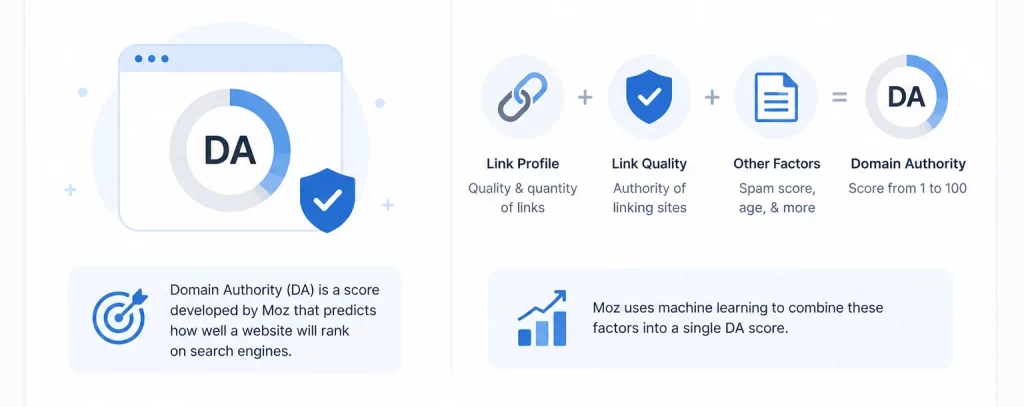
Domain Authority is Moz’s machine learning score that predicts how likely a domain is to rank in Google’s search results. It runs on a logarithmic 1–100 scale.
Moz doesn’t use a fixed formula. Their model continuously searches for the “best-fit algorithm that correlates link data with actual Google search positions.” If Domain A appears more often in SERPs than Domain B, Domain A scores higher — regardless of raw link count.
The main inputs Moz feeds into DA:
- Linking root domains — unique external domains pointing to your site (100 links from one domain = 1 root domain)
- MozRank — link popularity modeled on PageRank concepts
- MozTrust — proximity to known trusted seed domains on the web
- Spam Score — the percentage of linking domains flagged as low-quality
- On-page signals — site architecture, content structure, keyword usage
Key Insight: DA is comparative. Your score exists relative to every other domain in Moz’s index. That means DA can drop even when your own backlink profile improves — if competitors grew faster during the same period.
Moz introduced DA 2.0 in 2019, adding neural network processing and spam detection. The MozBar was updated again in April 2025, keeping DA a live, actively maintained metric. Scores update roughly monthly.
What Is Domain Rating — and How Does Ahrefs Calculate It?
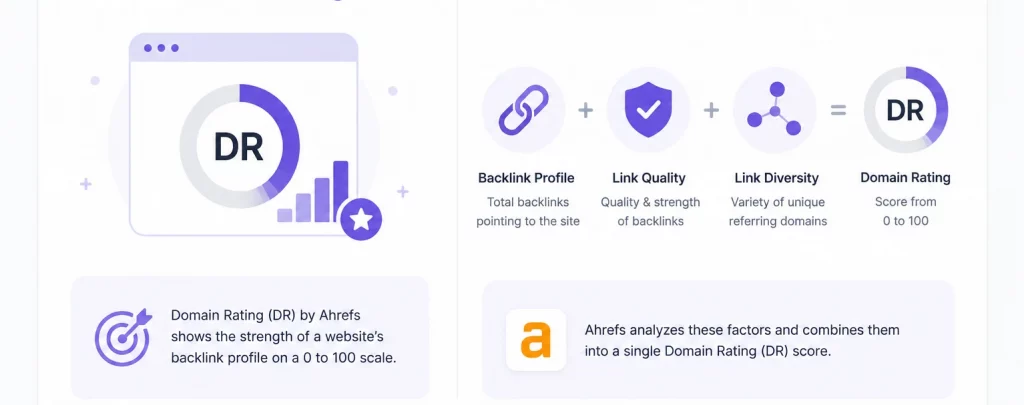
Domain Rating is Ahrefs’ measure of backlink profile strength on a 0–100 logarithmic scale. It focuses on one thing: the number and quality of unique referring domains pointing at your domain.
Here’s the core logic:
- Ahrefs crawls the web daily and builds one of the largest known link graphs
- Each referring domain contributes DR value based on its own DR score
- That value is divided by how many unique external domains the referring site links out to
The critical math: A DR 65 site linking to 15 external domains passes far more value per link than a DR 75 site linking to 3,000 external domains. Link generosity dilutes the value passed per link.
Key Insight: DR deliberately excludes traffic, spam signals, domain age, and all non-link variables. A site can have a very high DR and terrible organic rankings if the referring domains aren’t topically relevant.
Ahrefs updates DR continuously through its daily crawler. New backlinks can move your DR within days — much faster than DA, which updates monthly.
What Are the Key Differences Between DA and DR?
Both run on 0–100 logarithmic scales. Both involve backlinks. But their design philosophies are fundamentally different.
| Factor | Domain Authority — Moz | Domain Rating — Ahrefs |
|---|---|---|
| Creator | Moz | Ahrefs |
| Primary inputs | 40+ signals: links, spam, structure, ML model | Backlink graph only: referring domains + quality |
| Metric type | Relative — compared against all sites in Moz index | Absolute — pure backlink-graph strength |
| Update frequency | ~Monthly | Daily (continuous crawl) |
| Spam sensitivity | High — Spam Score is a direct input | Low — spam links aren’t directly penalized |
| Manipulation risk | Harder to game | Easier — redirect chain inflation is common in 2026 |
| Best used for | Competitor benchmarking, client reporting | Link prospecting, backlink profile analysis |
| Google ranking factor | No | No |
The clearest way to think about it: DR tells you how strong a backlink profile looks. DA tries to predict whether that profile translates into actual ranking performance. Different questions. Different tools.
Does DA or DR Actually Affect Google Rankings?
No. This is the most persistent myth in the industry.
Google does not use Domain Authority or Domain Rating as ranking signals. Their own documentation confirms Search uses “many signals, mostly at the page level.” PageRank — Google’s internal link evaluation — remains private and inaccessible to any third-party tool.
Moz states directly on its platform that Google does not factor DA into rankings. John Mueller has confirmed this multiple times publicly.
Here’s why the correlation exists — and why it isn’t causation.
Sites with strong backlink profiles tend to rank better. DA and DR both measure backlink strength. So high-DA sites ranking well reflects a correlation between real link authority and rankings — not evidence that DA caused those rankings.
Warning: Buying links to raise DA or DR is high-risk in 2026. Google’s March 2026 Spam Update used SpamBrain — its AI spam detection system — to target manipulative link patterns. Sites saw ranking drops while their DR stayed high. The score moved. The rankings didn’t.
Why Does the Same Site Show Different DA and DR Scores?
This is the most common confusion SEOs encounter. Four structural differences explain the gap.
1. Crawl timing. Ahrefs crawls daily. Moz crawls monthly. A new backlink can appear in DR within days but may not surface in DA for weeks.
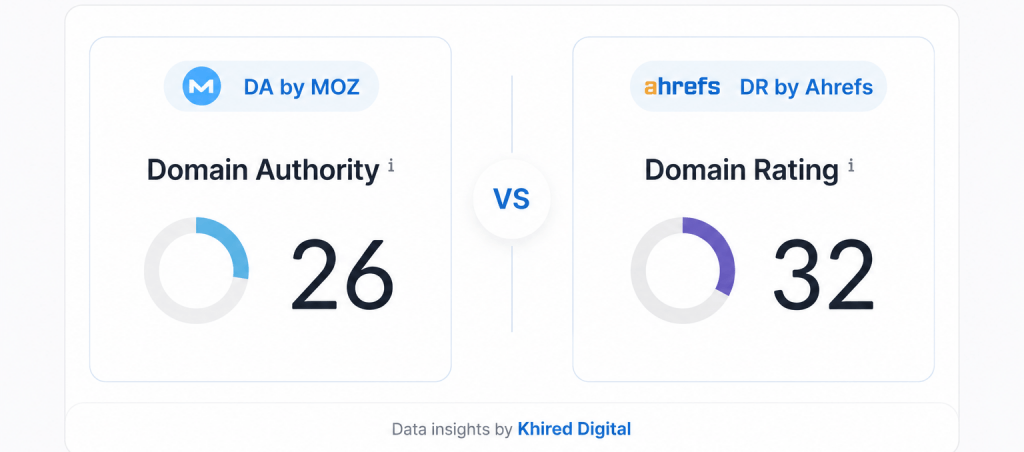
2. Spam handling. Moz directly penalizes spam through Spam Score. Ahrefs doesn’t. A site with many low-quality links will often show higher DR than DA.
3. Algorithm scope. DR focuses purely on the backlink graph. DA uses 40+ signals including spam, architecture, and ML-based ranking prediction. Same domain — structurally different outputs.
4. Moz recalibration events. Moz periodically retrains its DA model. When this happens, scores across the entire index shift simultaneously. A 2–3 point drop after a Moz update is normal noise — not a ranking emergency.
Key Insight: A large DR-over-DA gap often signals backlinks that look strong on paper but aren’t translating into real ranking signals. According to Rhino Rank’s February 2026 analysis, this gap frequently indicates redirect chain inflation, PBN links, or a high Moz Spam Score. Always verify a high-DR site with organic traffic data before treating it as a quality link source.
What Is DA and DR Manipulation — and How Do You Detect It?
DR manipulation is the most documented black-hat metric tactic in 2026.
The playbook is simple. An operator buys expired domains that still have real backlinks from their previous legitimate existence. They redirect those domains to a target site. Ahrefs sees the referring domain count rise. DR climbs. Organic traffic doesn’t follow — because Google’s SpamBrain devalues the links and the topical relevance is nonexistent.
Red flags for inflated DR:
- High DR + near-zero organic traffic in Ahrefs Site Explorer
- Referring domains that are all recently registered or recently redirected
- Domain age is very recent but DR is unusually high for the timeline
- Moz Spam Score is high while Ahrefs DR is high — the two tools disagree
- Anchor text is heavily over-optimized with exact-match commercial keywords
DA inflation is harder but not impossible. Common tactics include spam link buying from link farms, bot-driven traffic injection to fake engagement signals, and AI-generated content blitzes to temporarily inflate keyword visibility. Moz’s spam detection has improved significantly since DA 2.0, making pure DA inflation increasingly difficult relative to DR inflation.
When Should You Use DR vs DA in Your SEO Work?
The right metric depends entirely on the task in front of you.
Use DR when:
- Evaluating a site for a guest post or link placement
- Comparing the raw backlink strength of two prospective link sources
- Monitoring your own backlink profile growth over time
- Investigating whether a competitor’s authority is real or inflated
Use DA when:
- Benchmarking your domain against direct competitors for overall SEO health
- Presenting authority metrics to clients in a single intuitive number
- Evaluating acquisition targets, partnerships, or PR placement sites
- Tracking directional month-over-month progress of your SEO program
Use both together when:
- Running a full link prospecting campaign (DR for link equity; DA for overall health)
- Auditing a competitor’s authority before a content gap campaign
- Deciding whether to disavow links (check both tools before acting)
What Does “Good” DA and DR Look Like?
There’s no universal benchmark. DA 35 is competitive for a local service business and completely inadequate for a national finance brand.
The only benchmark that matters: what do the top five pages currently ranking for your target keyword show? That’s your actual competition — not an abstract industry average.
Here are the starting points by segment:
| Industry Segment | Competitive DA Range | Key Note |
|---|---|---|
| Local services (law, dental, HVAC) | 25–45 | Topical depth often beats raw DA here |
| SaaS / B2B tech | 45–65 | High content volume from well-funded competitors |
| Finance / insurance | 60–80+ | YMYL + E-E-A-T raises the threshold significantly |
| Health / medical | 55–75+ | Credentialed authorship is now a prerequisite |
| E-commerce (niche) | 35–55 | Page Authority often matters as much as domain DA |
| Digital marketing agencies | 30–55 | Niche focus and content depth accelerate growth |
SearchAtlas’s 2026 analysis of 400+ SEO campaigns found a critical data point: sites that build topical authority first see ranking gains up to 3x faster than those chasing DA alone. Deep, interlinked content within a specific subject cluster is increasingly outcompeting raw link metrics for niche queries.
What Changed in 2026 That Affects These Metrics?
Three developments have materially shifted how DA and DR fit into a 2026 SEO strategy.
Google’s March 2026 Spam Update. SpamBrain’s March rollout (19.5-hour global deployment) targeted mass-produced AI content, scraped material, and manipulative link patterns. Sites with inflated DR from PBN or redirect-chain tactics saw ranking drops while their DR remained unchanged. The metrics moved. The results didn’t. This confirms that DR is increasingly a lagging indicator of actual Google trust.
Topical authority is outranking link authority on niche queries. Google’s helpful content system continues rewarding genuine expertise depth. According to SearchAtlas, sites with strong topical authority but moderate DA are outranking legacy brands for long-tail and niche queries. This is the most important strategic shift in how authority works in 2026 — and it’s not reflected in either DA or DR.
AI search surfaces evaluate authority differently. ChatGPT, Perplexity, Claude, and Google AI Overviews surface content based on signals that don’t map directly to DA or DR. These platforms reward E-E-A-T signals, original data, and structured content — things both metrics were never designed to measure. In 2025 and 2026, a growing share of brand discovery happens through these platforms, not through traditional SERP clicks. Your DA and DR don’t tell you how you’re performing in that environment.
How Do You Increase DA and DR the Right Way?
Both metrics respond to the same core inputs: editorially earned backlinks from topically relevant, high-traffic sites. Here’s what actually works in 2026.
For DA growth:
- Build editorial links from real, established sites with low Moz Spam Score
- Audit and clean up toxic backlinks — use Disavow only for verified manual actions or clear negative SEO attacks, not routine cleanup
- Improve site architecture and internal linking — DA factors in structural signals beyond backlinks
- Publish original research that earns natural citations from industry sources
For DR growth:
- Prioritize quality over quantity in referring domains — a DR 55 site linking to 15 external domains passes more value than a DR 75 site linking to 3,000
- Target editorial placements on niche-relevant sites with verified organic traffic
- Reclaim 404 links pointing to moved or deleted pages — fast DR wins without new link building
For both:
- Create content comprehensive enough to earn natural backlinks at scale
- Avoid link exchanges, PBNs, and paid placements that violate Google’s spam policies
- Track both metrics monthly alongside organic traffic — if DR rises but traffic doesn’t, investigate before celebrating
Conclusion: Use Both. Chase Neither.
Domain Authority and Domain Rating are tools, not targets.
The inputs that move both — editorially earned links from relevant domains, deep topical content, clean site architecture, low spam profile — are the same inputs that drive real organic performance.
In 2026, topical authority is increasingly outpacing raw link metrics. AI search surfaces are reshaping what authority means entirely. The most durable SEO strategy builds genuine expertise. Not inflated scores.
Use DA to benchmark where you stand. Use DR to evaluate where your links are landing. Use organic traffic to measure what’s actually working. Build the real thing — and the metrics will follow.
Want a free DA and DR audit for your website?
Khired Digital’s SEO team analyzes your full backlink profile, Spam Score, and topical authority gaps — then builds a link strategy around what actually moves rankings, not just metrics.
🌐 digital.khired.com 📧 info@khired.com 📞 +92 336 5566265
Frequently Asked Questions
Is Domain Authority or Domain Rating more important for SEO in 2026?
Neither is a Google ranking factor, so neither directly drives rankings. DR is more useful for evaluating specific link opportunities. DA gives a broader multi-signal snapshot useful for competitor benchmarking. The most important signal is organic traffic from relevant keywords — use DA and DR as directional tools, not as goals.
Why is my DR so much higher than my DA?
The most common cause is spam signals. Moz penalizes spam link patterns directly through Spam Score; Ahrefs does not. The gap can also indicate redirect chain inflation — purchased or redirected expired domains inflating referring domain counts in Ahrefs without creating real ranking signals.
Can I trust a site with DR 70 as a good link source?
Not automatically. A DR 70 site with near-zero organic traffic is a red flag for manipulation. Always verify a prospective link source using both DR and organic traffic data in Ahrefs. A DR 40 site with 8,000 monthly visitors in your niche is a stronger link than a DR 70 site with inflated metrics and no real audience.
How often should I check my DA and DR?
Monthly is sufficient for most sites. Moz updates DA monthly; Ahrefs updates DR continuously, but meaningful trends need at least a 30-day window. Weekly monitoring creates noise without actionable signal.
Does DA or DR influence AI Overview citations?
Indirectly. AI Overviews prioritize pages already ranking in the top 20 organic results — and link authority is one input into those rankings. But AI systems increasingly reward E-E-A-T signals, structured content, and original data — things neither DA nor DR directly measures.
Should my agency focus on building client DA or DR first?
Focus on DR first for link-building feedback — it updates faster and reflects link acquisition quality more directly. Use DA for monthly client reporting and competitive positioning. Both should improve naturally as a result of high-quality link building and strong content. Chasing scores directly — rather than the inputs that drive them — produces inflated metrics without ranking gains.

0 Comments