

The process of scrolling through Instagram leads you to discover an impressive advertisement that promotes a new smartwatch. The advertisement does not provide detailed information about the product’s technical specifications or its purchasing locations but instead poses the question, “Tired of missing important calls while cycling?”
The advertisement employs contemporary customer-focused marketing methods, which base its structure on the 4C’s of marketing instead of traditional advertising techniques. The framework enables businesses to view all aspects through their customers’ perspectives.
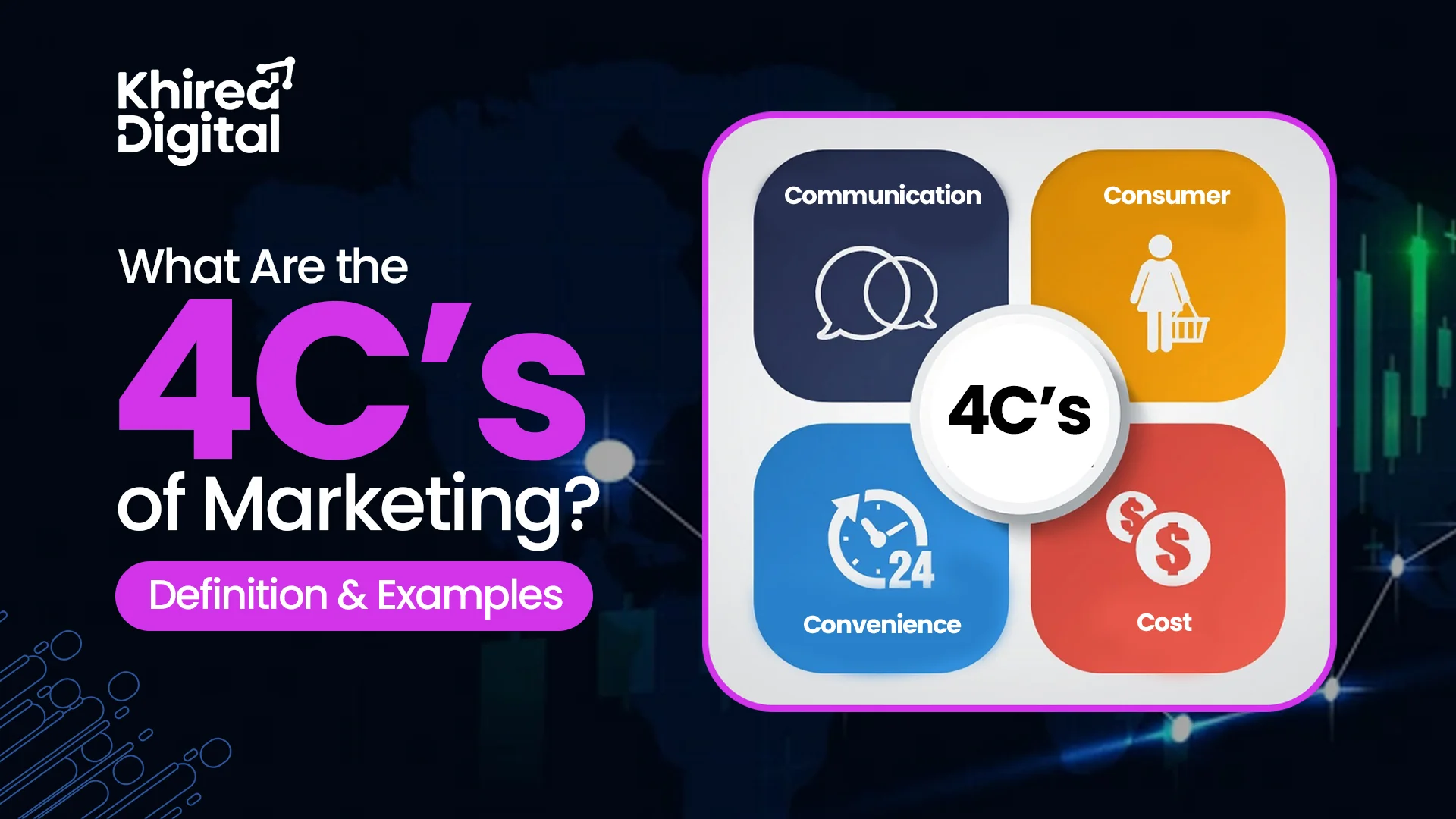
The 4C model, consisting of customer, cost, convenience, and communication, has become essential for businesses that want to create successful campaigns. It builds customer relationships in the current digital environment, where customers have complete control.
This blog highlights the 4Cs of marketing along with examples.
So, let’s start.
4Cs of Marketing
Discussed here is the detailed analysis of the 4Cs of marketing:
1. Customer: Solve Their Problem, Don’t Just Sell Your Thing
The first C changes attention away from the product and toward the customer. Rather than wondering what we are selling, you query what problem your customer needs to address. Your product or service is just the answer.
A good website builder is the customer’s wish for a professional online presence without having to code; it is not merely technology. A meal-kit delivery service is the customer’s requirement for quick, nutritious meals that save time, not a box of components.
Example: A SaaS company doesn’t present a list of features at first. On its homepage, it states, “Stop wasting hours on manual reports. Create Ideas in a Few Minutes.” The product is presented solely as the answer to the customer’s particular problem.
2. Cost: It’sMore Than Just Money
The second C expands the price into the overall cost. Price is only the monetary amount; cost covers all that the customer gives up getting your product. This encompasses the time invested in becoming proficient in using your product, the mental strain of a challenging sign-up procedure, and the risk of selecting you instead of a rival. Reducing the non-financial expenses is your aim; increasing seen value is your direction.
Example: A virtual retailer provides simple, no-hassle returns within 100 days. This greatly lowers the client’s risk cost impression. By removing the financial cost barrier and enabling consumers to spend time learning the platform risk-free, a project management tool provides a strong free-forever plan.
3. Convenience: Be Wherever and Whenever They Are
The third C turns place into convenience. Making the purchasing process simple is more important than simply having physical or virtual shelf space. Could the customer find you on the social network they use most? Are they capable of buying with two clicks from their smartphone? Is your website at lightning pace? In digital marketing, convenience means eliminating every little obstacle.
Example: Instagram Shopping tags let customers buy the outfit they see in a reel without exiting the app. Eliminating the need for long email threads, a B2B service has a “Book a Demo” calendar widget directly on its price page. This is convenience in action.
4. Communication: Two-Way Dialogue, Not One-Way Broadcast
The last and most important C transforms promotion—a one-way broadcast—into two-way dialogue, communication. Designed for interaction, not just notification, are digital channels. This means commenting, replying to DMs, using social listening to follow discussions about your brand, and generating material that encourages interaction—polls, Q&As, and user-generated content initiatives.
Example: A company won’t only release a fresh product launch video. It sponsors a live YouTube Q&A with its product creators and tweets a Twitter thread looking for feature wishlists. Also, it proactively replies to every comment with tailored responses. This generates trust and community far beyond any conventional advertisement.
What is the Difference Between 4Ps and 4Cs of Marketing?
The difference is a fundamental shift in perspective, crucial for the digital age. The 4Ps represent the seller’s viewpoint—the tools the marketer controls. The 4Cs represent the buyer’s viewpoint—the experience the customer values. The 4Cs don’t make the 4Ps obsolete; they modernize them. A customer-centric (4C) strategy informs how you develop your product, set your price, choose your place, and execute your promotion.
4P’s (Brand’s View) | 4C’s (Customer’s View) | Core Question for Digital Marketers |
Product | Customer | What solution does my audience truly need? |
Price | Cost | What is the total cost (money, time, and effort) to my user? |
Place | Convenience | How can I make the journey frictionless? |
Promotion | Communication | How can I start a conversation, not just send a message? |
Final Thoughts
The 4C’s of marketing deliver essential customer-centric perspectives, which organizations need to succeed in the current digital business environment. Your business needs to focus on solving customer problems while maintaining low operational expenses, creating easy access points for all contact moments, and establishing authentic communication channels.
Your framework will deliver digital content that people can see as valuable content while your digital assets achieve optimal reach and engagement. Your marketing becomes a direct invitation to your audience through this approach.
Ready to build a digital marketing strategy that puts your customer at the heart of every campaign? Khired Digital works as our strategic partner. Let’s apply the 4C’s to expand your brand presence while building your community and achieving greater success.
Frequently Asked Questions
Should I use the 4Ps or the 4Cs for my digital strategy?
You must begin with the 4Cs because both methods need to be executed. The 4C framework helps you understand your customer needs and their product experience. The 4Cs explain the reason for existence, while the 4Ps describe the method of implementation.
Which 'C' is the most important in digital marketing?
People find the process of communicating through digital channels demands more effort, yet needs digital platforms enable brands to establish trust through authentic two-way communication. It builds stronger relationships with their audience while providing them with real-time feedback that boosts their three C’s performance.
Can the 4Cs be applied to a service-based business?
Absolutely. In fact, they are often more relevant. For a digital marketing agency: Customer = The client’s growth goals. Cost = The agency’s fee + the client’s time in meetings. Convenience = Easy onboarding, clear reporting dashboards. Communication = Regular strategy calls and transparent updates.

0 Comments